
- Germany has no general approval for sidewalk delivery robots. Deployments run on time-limited special permits.
- Pilot projects: REWE and Starship in Hamburg-Barmbek (October 2025 to April 30, 2026, ended as scheduled), Cartken robots in Bielefeld since January 2026.
- Up to 6 km/h, no compulsory motor insurance (Section 1a PflVG); no owner liability under Section 7 StVG for vehicles up to 20 km/h (Section 8 StVG).
- Japan has allowed registered robots up to 6 km/h since April 1, 2023; South Korea certified robots up to 500 kg and 15 km/h since November 17, 2023.
- Serving robots: the EU Machinery Regulation 2023/1230 applies from January 20, 2027; employers must include them in their risk assessment.
Six wheels, a flag, walking pace: delivery robots have become part of everyday life in some German neighborhoods. In Hamburg-Barmbek, they brought groceries from the supermarket to people's doors from fall 2025 until the end of April 2026, and in Bielefeld they have been driving through a residential neighborhood since early 2026. Even so, there is one question many people can't answer clearly: are delivery robots even legal in Germany? In short: there is no general law that permits sidewalk robots. Every deployment runs on a special permit, and that permit is time-limited.
Internationally, the picture is very different. Several US states, Estonia, Japan and South Korea have their own rules for delivery robots, often with clear limits on speed, size and insurance. This guide describes the legal situation for delivery robots as of October 2026. It shows where Germany stands, what other countries do differently and what applies to serving robots in restaurants. At the end, there is a checklist for municipalities, retailers and restaurant operators. Important: this text is not a substitute for legal advice.
Are delivery robots legal in Germany?
On sidewalks, only with a special permit. German traffic law strictly separates vehicles and pedestrians. There is no dedicated category for small, self-driving transport devices. Starship Technologies, probably the best-known maker of sidewalk robots, put it this way in the Bundestag's lobby register in March 2026: the Road Vehicle Licensing Regulation (StVZO) does not contain a suitable vehicle category. Deployment is therefore only possible on a temporary, trial basis with a special permit.
The Small Electric Vehicles Regulation (eKFV), which governs e-scooters, doesn't help either. It only applies to vehicles with a handlebar or steering column, a top speed between 6 and 20 km/h and an empty weight of no more than 55 kg. Delivery robots have no handlebar and usually travel no faster than 6 km/h. So they fall through the cracks.
What could change: on July 20, 2026, the Federal Ministry of Transport presented a draft bill. Under it, the StVZO and the Vehicle Approval Regulation are to be replaced by a new Vehicle Approval and Operation Regulation (FGBV), planned for January 1, 2029. Whether this will create a dedicated category for delivery robots is not clear from the information published so far. That remains open. Manufacturers are certainly pushing for it. In January 2026, Starship sent a position paper to members of the Bundestag calling for a legal basis for commercial operation.
Does the autonomous driving law also apply to delivery robots?
Germany's Autonomous Driving Act has been in force since July 28, 2021. It allows motor vehicles with an autonomous driving function (Level 4) to operate in regular service within a defined operating area on public roads. Requirements include an operating permit from the Federal Motor Transport Authority (KBA) and technical supervision – a person who can deactivate the vehicle remotely and approve driving maneuvers. The ministry cites shuttles, hub-to-hub traffic and first- and last-mile freight transport as possible use cases.
For driverless delivery vans on the road, this is a workable framework. For sidewalk robots, it is not: the law targets motor vehicles in road traffic, not devices moving among pedestrians. The fact that the industry is still calling for a dedicated legal basis in 2026 shows that the 2021 law has not closed this gap in practice.
Where are delivery robots already operating in Germany?
Two current examples are well documented:
- Hamburg-Barmbek: REWE tested Starship robots from October 2025 until the scheduled end on April 30, 2026. They delivered within a radius of about two kilometers around a store, Monday to Saturday from 8 a.m. to 9 p.m., at just under 6 km/h. Beverage crates, frozen goods and items from the fresh counter were excluded. A first test took place in Hamburg-Eimsbüttel in 2023. According to media reports, the robots were TÜV-certified and backed by a control center that can intervene remotely.
- Bielefeld-Lohmannshof: Since January 2026, robots from the manufacturer Cartken have been delivering groceries in this residential neighborhood. The "AQ-Shuttle" project is run by Bielefeld University of Applied Sciences, the city's transport department and the transit operator moBiel. It is funded by the North Rhine-Westphalia Ministry of Transport. The city has issued special permits for sidewalk use. According to the project partners, there is no uniform nationwide rule.
Both examples show the pattern: in Germany, delivery robots today are pilot projects with local permits, not regular operations.
Who is liable in an accident involving a delivery robot?
This is where things get legally complicated, and some issues have not yet been settled by the courts. Two points are explicitly set out in the law:
- Compulsory insurance: The Compulsory Insurance Act applies only to motor vehicles with a design-related top speed of more than 6 km/h (Section 1a PflVG). A robot whose design limits it to 6 km/h therefore does not need motor vehicle liability insurance.
- Owner liability: Under Section 8 StVG, strict owner liability under Section 7 StVG does not apply to motor vehicles that cannot exceed 20 km/h. The only exceptions are autonomous vehicles under Section 1d StVG in autonomous mode and e-scooters under the eKFV.
Victims are still not left without protection. General liability for culpably caused damage (tort law) and the manufacturer's product liability continue to apply. How authorities address liability in a special permit depends on the individual case. Municipalities and operators should therefore contractually require adequate business liability insurance, even if the law doesn't mandate it.
How do Estonia, Finland and the UK regulate delivery robots?
Estonia was a pioneer. On June 14, 2017, parliament amended the Traffic Act and created a dedicated category for self-driving delivery robots. Key points: a maximum of 6 km/h, liability insurance for the operator and a visible label with the operator's name and phone number. The person operating the robot must be at least 18 years old.
Finland classifies delivery robots as "light automated goods vehicles" under vehicle law. Since January 1, 2024, more detailed technical requirements from the transport agency Traficom have applied: dimensions and weight (the limits were lowered), lights and reflectors, brakes and acoustic signals so that visually impaired people can also notice the robots.
The United Kingdom does not yet have its own law for delivery robots. Starship has been operating in Milton Keynes since 2018, initially for the supermarket chain Co-op, and says it obtained approval for each location from the local council. In June 2026, the UK trade press reported that the government is preparing a legal change for sidewalk robots in England. There is no timetable. Pedestrian groups such as Living Streets have raised concerns about safety and accessibility. Whether and when the law will come is open.
Delivery robot laws: What applies to delivery robots in the US?
In the US, sidewalk robots are regulated by the states, usually under the term "personal delivery device" (PDD). Virginia was one of the first states to pass such a law, in 2017. By September 2021, according to an analysis by Next City magazine, 21 states had PDD laws. Later figures from industry sources are higher but not consistently documented.
Typical rules:
- Status: On sidewalks, robots usually have the rights and duties of pedestrians and must yield to them.
- Speed: Virginia allows up to 10 miles per hour (about 16 km/h) on sidewalks. There, robots may only travel on the roadway if no sidewalk is available, and only on roads with a speed limit of no more than 25 mph. Across states, sidewalk limits in 2021 ranged from 3.5 to 12 mph.
- Weight: According to Next City's analysis, empty-weight limits in 2021 were mostly between 80 and 100 pounds, depending on the state.
- Insurance: Virginia requires at least $100,000 in liability coverage. Similar amounts are common in many states.
- Identification: A visible device number and information about the operator.
How much leeway cities have varies from state to state. Virginia allows municipalities to impose additional safety requirements but prohibits them from banning permitted roadway operation. Driverless delivery vehicles on the road, by contrast, fall under the federal agency NHTSA. On February 6, 2020, it granted Nuro a first temporary exemption: two years, for up to 5,000 R2 vehicles.
Japan, South Korea and China: Is Asia already further ahead?
Japan amended its Road Traffic Act as of April 1, 2023, introducing the category "remotely operated small vehicle." The rules: a maximum of 6 km/h, no more than 120 cm long, 70 cm wide and 120 cm high, electric drive and an emergency stop. Anyone who operates such a robot remotely in public spaces must notify the responsible police at least one week in advance. No permit is required. The robots are treated as pedestrians, travel on the sidewalk, obey traffic lights and must carry a label.
South Korea amended two laws in 2023. The amended Road Traffic Act has applied since October 2023, and the Intelligent Robots Development and Distribution Promotion Act since November 17, 2023. Since then, safety-certified outdoor robots weighing up to 500 kg and traveling up to 15 km/h may use sidewalks as pedestrians. Operators must be insured.
China relies more on larger driverless delivery vehicles for the road than on sidewalk robots. According to the party newspaper People's Daily, more than 6,000 such vehicles were in commercial operation at the end of 2024, and by mid-2025 more than 100 cities had opened roads to them. Operators need road and operating permits.
What rules apply to serving robots and indoor delivery robots?
Serving robots in restaurants and transport robots in hotels or hospitals usually don't operate in public traffic areas. Road traffic law therefore generally plays no role for them. The main rules are machinery and occupational safety law:
- Machinery law: The Machinery Directive 2006/42/EC with CE marking still applies today. From January 20, 2027, it will be replaced by the EU Machinery Regulation 2023/1230. Among the changes, manufacturers of machines with autonomous or learning functions must also take into account risks that arise after sale. There are also stricter cybersecurity requirements. Devices placed on the market under the old rules before the cutoff date may continue to be sold.
- Occupational safety: Employers using serving robots must include them in the risk assessment under the German Occupational Safety and Health Act. This covers walkways, tight spots, collisions, staff training and work pace.
Conclusion
Delivery robots are not banned in Germany, but they are not generally permitted either. Every deployment on the sidewalk requires a time-limited special permit, as the projects in Hamburg and Bielefeld show. The 2021 Autonomous Driving Act helps driverless delivery vans but does not solve the problem of sidewalk robots. Whether the planned overhaul of vehicle law by 2029 will bring a dedicated category is open. Other countries are further ahead: Estonia, Japan, South Korea and many US states have set clear limits on speed, size and insurance. For serving robots in restaurants, on the other hand, product safety law is what matters most, and it will become stricter with the Machinery Regulation from January 2027.
Checklist: What municipalities, retailers and restaurant operators should check
- Clarify where it operates: Will the robot travel on public sidewalks, on the road or only on private property? This determines which law applies.
- Apply for a permit: For sidewalks in Germany, apply for a special permit from the responsible road traffic authority. Plan for conditions on times, area and supervision.
- Mind the duration: Special permits are time-limited. Factor in extension and evaluation from the start.
- Settle liability and insurance: Even without statutory compulsory insurance, contractually require business liability insurance with adequate coverage.
- Review remote monitoring: Who monitors the robots, how quickly can someone intervene, and how many devices does one person oversee?
- Ensure accessibility: Take sidewalk widths, wheelchairs, strollers and visually impaired people into account. Check acoustic and visual signals.
- Clarify data protection: Cameras and sensors capture public spaces. Define purpose, retention period and blurring in the data protection concept.
- Review the product range: Organize age verification for alcohol and tobacco as well as cold chains. In the Hamburg project (until April 2026), for example, frozen goods and beverage crates were excluded.
- Serving robots in restaurants: Check the CE marking and declaration of conformity. For new devices from January 20, 2027, look for compliance with the Machinery Regulation. Include the robot in the risk assessment and train staff.
- Keep an eye on the legal situation: Follow the FGBV draft, possible legislative initiatives and court rulings. For specific projects, seek expert legal advice.
Frequently asked questions
Are delivery robots legal in Germany?
On public sidewalks, only with a time-limited special permit. German vehicle approval law does not yet have a dedicated vehicle category for delivery robots.
Is there a delivery robot law in Germany?
No, as of October 2026 there is no dedicated law. Manufacturers are calling for a legal basis. Whether the planned new Vehicle Approval and Operation Regulation (FGBV, planned from 2029) will cover delivery robots is open.
Does the autonomous driving law apply to delivery robots?
The 2021 law regulates autonomous motor vehicles (Level 4) in defined operating areas on the road. It does not create a suitable basis for robots on sidewalks.
Who is liable if a delivery robot causes an accident?
Robots up to 6 km/h are not subject to compulsory motor insurance, and owner liability under Section 7 StVG generally does not apply to vehicles up to 20 km/h. General fault-based liability and product liability remain. Operators should therefore take out business liability insurance.
How fast are delivery robots allowed to go?
It depends on the country: in Estonia and Japan, no more than 6 km/h; in South Korea, up to 15 km/h; in Virginia (US), up to 10 mph on sidewalks. The robots in the Hamburg pilot (until April 2026) traveled at just under 6 km/h.
Which countries have laws on delivery robots?
Dedicated rules exist in Estonia (2017), Finland, Japan (2023), South Korea (2023) and many US states, among others. In 2021, 21 states had personal delivery device laws. The UK is preparing regulation.
Sources
- Lobbyregister Bundestag: Starship – Gesetzliche Grundlage für autonome Lieferroboter (lobbyregister.bundestag.de)
- § 1 Elektrokleinstfahrzeuge-Verordnung (eKFV) (gesetze-im-internet.de)
- § 1a Pflichtversicherungsgesetz (PflVG) (gesetze-im-internet.de)
- § 8 Straßenverkehrsgesetz (StVG) (gesetze-im-internet.de)
- BMV: Gesetz zum autonomen Fahren (bmv.de)
- ZKF: BMV plant Neuordnung der StVZO (FGBV) (zkf.de)
- Lebensmittel Praxis: Rewe testet Lieferroboter in Hamburg-Barmbek (lebensmittelpraxis.de)
- FINK.HAMBURG: Mein Nachbar, der Lieferbot (fink.hamburg)
- moBiel: Roboter liefern am Lohmannshof (AQ-Shuttle Bielefeld) (mobiel.de)
- NJORD Law: Estland erlaubt Lieferroboter (Traffic Act) (njordlaw.com)
- Traficom: Technische Anforderungen an Transportroboter (traficom.fi)
- Retail Gazette: Delivery robots could be heading for England's pavements (retailgazette.co.uk)
- AFP/Kuwait Times: Delivery robots in Milton Keynes (kuwaittimes.com)
- Code of Virginia § 46.2-908.1:1 Personal delivery devices (law.lis.virginia.gov)
- Next City: Are Robots Coming to a Sidewalk Near You? (nextcity.org)
- NHTSA: Exemption for Nuro R2 (nhtsa.gov)
- Präfekturpolizei Kagoshima: Ferngesteuerte kleine Fahrzeuge (Meldesystem) (pref.kagoshima.jp)
- Korea JoongAng Daily: Robots can now legally roam Korea's sidewalks (koreajoongangdaily.com)
- People's Daily: Over 6,000 autonomous delivery vehicles in China (en.people.cn)
- Produktion: Maschinenverordnung – was sich ab 2027 ändert (produktion.de)
- Lebensmittel Praxis: Rewe beendet Testbetrieb mit Lieferrobotern in Hamburg (lebensmittelpraxis.de)
Related robots
Pudu T300
Pudu Robotics · China · 2025 · Delivery robots
- Height: 135 cm
- Weight: 65 kg
- Runtime per charge: 6 hrs
- Payload: 300 kg
- Industry, Bearings, Factory
Keenon BUTLERBOT W3
Keenon Robotics · China · Delivery robots
- Height: 108.1 cm
- Weight: 48 kg
- Runtime per charge: 12 hrs
- Payload: 20 kg
- Hotel
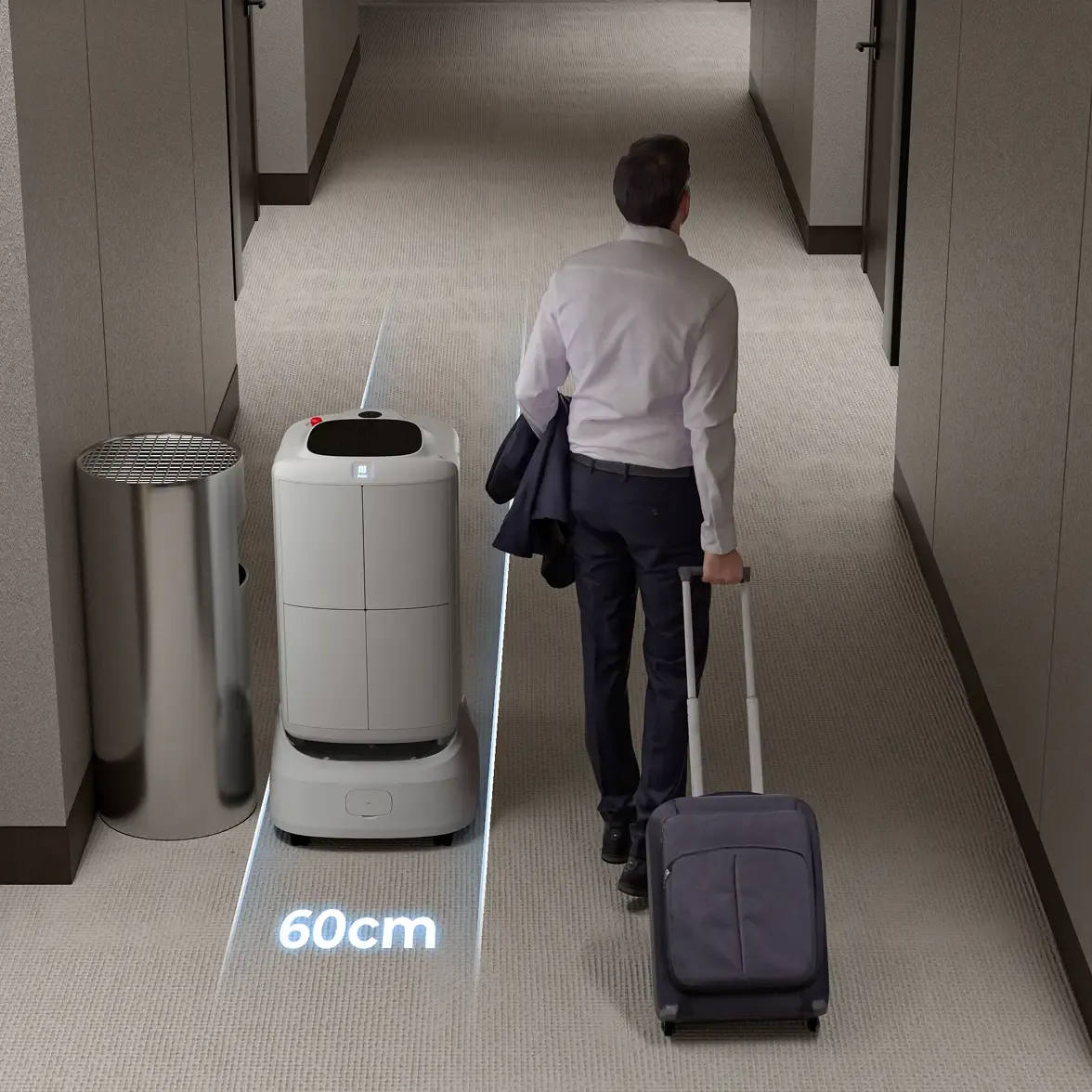 Image: Pudu Robotics
Pudu FlashBot Max
Pudu Robotics · China · 2025 · Delivery robots
- Height: 105.2 cm
- Weight: 60 kg
- Runtime per charge: 9 hrs
- Top speed: 4.3 km/h
- Multi-story buildings, Hotel room service, Semi-outdoor
 Image: Piaggio Fast Forward
Piaggio gitamini
Piaggio Fast Forward · Delivery robots
- Height: 48 cm
- Weight: 12.7 kg
- Runtime per charge: 7 hrs
- Payload: 9 kg
- Robot that follows pedestrians, Shopping
Pudu HolaBot
Pudu Robotics · China · Delivery robots
- Height: 122.6 cm
- Weight: 60 kg
- Payload: 60 kg
- Top speed: 4.3 km/h
- Restaurant (dish return), Hospital, Office
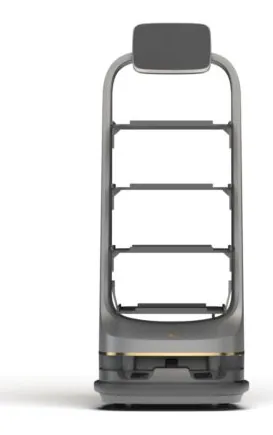 Image: Gausium
Gausium Delivery X1
Gausium · China · Delivery robots
- Height: 125 cm
- Weight: 35 kg
- Payload: 30 kg
- Top speed: 4.3 km/h
- Restaurant, Hospital, Hotel