- There is no dedicated law for humanoid robots – machinery, AI, product safety, cybersecurity, liability and data protection law apply.
- The Digital Omnibus (Regulation (EU) 2026/1744, in force since July 27, 2026) postpones high-risk AI to December 2, 2027 (Annex III) and August 2, 2028 (Annex I).
- The Machinery Regulation (EU) 2023/1230 applies from January 20, 2027; learning AI safety functions require an assessment by a notified body.
- Germany's new Product Liability Act is set to enter into force on December 9, 2026: software and AI count as products, and injured parties get an easier burden of proof.
- Companies must carry out a risk assessment before deployment; with cameras and remote control, the GDPR must be observed.
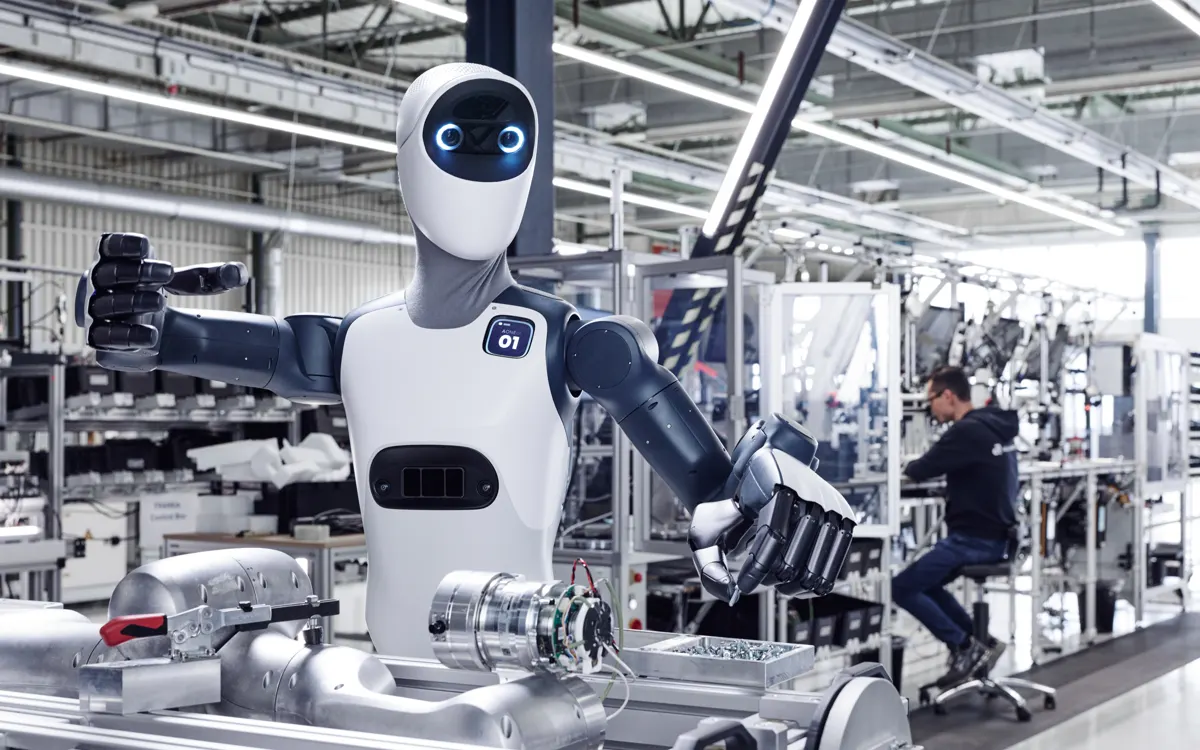
Humanoid robots are leaving the research labs: the first models are working on factory floors and in warehouses, and manufacturers such as 1X are taking pre-orders for household robots. Yet neither the EU nor Germany has a dedicated "humanoid robot law." Instead, several sets of rules interlock – from the AI Act and the new Machinery Regulation to the reformed product liability law. Anyone who buys or operates a humanoid robot should know which obligations apply when, and who is liable if something goes wrong.
This guide summarizes the situation as of October 2026: what already applies, what is coming in 2027 and 2028, and what is still open. It is aimed at businesses, private households and anyone interested in the topic. One important note up front: this text provides an overview and is not a substitute for legal advice.
Is there a law specifically for humanoid robots?
No. Legally, a humanoid robot is above all a machine with software, sensors, radio modules and – in most cases – artificial intelligence. This results in a bundle of regulations, each covering one aspect:
- Machinery safety: the Machinery Directive 2006/42/EC until January 19, 2027, and the Machinery Regulation (EU) 2023/1230 from January 20, 2027.
- Artificial intelligence: the AI Act (EU) 2024/1689, since amended by the "Digital Omnibus on AI."
- Consumer product safety: the General Product Safety Regulation (GPSR).
- Cybersecurity: the cybersecurity requirements of the Radio Equipment Directive and the Cyber Resilience Act.
- Liability: the German Product Liability Act (Produkthaftungsgesetz), which will be fundamentally overhauled as of December 9, 2026.
- Data protection: the GDPR, as soon as cameras and microphones capture personal data.
- Occupational safety: the German Occupational Safety and Health Act, the Industrial Safety Regulation (Betriebssicherheitsverordnung) and DGUV rules when robots are used in a company.
Most obligations fall on manufacturers and importers. Operators – that is, companies and households that use the robot – have their own duties, however, especially in occupational safety and data protection.
What does the AI Act regulate for robots – and what has the Digital Omnibus changed?
The EU AI Act entered into force on August 1, 2024, and applies in stages. Since February 2, 2025, certain AI practices have been prohibited, and both providers and deployers must ensure AI literacy among their staff. Particularly relevant for robots is the ban on emotion recognition in the workplace and in educational institutions: a humanoid that analyzes employees' mood on the factory floor would therefore generally be prohibited. Since August 2, 2025, obligations have applied to general-purpose AI models, such as the large language models on which many robot assistants are built.
From August 2, 2026, the transparency obligations take effect. Anyone offering a robot with spoken dialogue must ensure that people recognize they are talking to an AI – unless this is obvious anyway.
The most important change of 2026 concerns the high-risk obligations. With Regulation (EU) 2026/1744, the so-called Digital Omnibus on AI, which entered into force on July 27, 2026, the EU has postponed the deadlines:
- High-risk AI under Annex III (such as biometrics, education, employment): from December 2, 2027, instead of August 2026.
- High-risk AI in regulated products under Annex I: from August 2, 2028.
Another point is decisive for robots: within the AI Act, the Machinery Regulation was moved from Section A to Section B of Annex I. As a result, the AI Act's technical high-risk requirements no longer apply directly to AI in machinery. Instead, the European Commission is to incorporate them into the Machinery Regulation by delegated act no later than August 2, 2028. The goal is a single conformity assessment instead of two parallel procedures. How strict these requirements will be in detail has not yet been decided – that depends on the content of the future delegated act.
Machinery Regulation 2027: What changes for humanoid robots?
The Machinery Regulation (EU) 2023/1230 applies from January 20, 2027, and replaces the Machinery Directive. As a regulation, it is directly applicable in all member states. It is the central safety framework for humanoid robots, because it is the first to explicitly address the risks of learning and connected machines.
- Self-learning behavior: Safety components and machinery with embedded systems that perform safety functions using machine learning and exhibit fully or partially self-evolving behavior are listed in Annex I, Part A. For these, a conformity assessment by a notified body is mandatory – self-certification by the manufacturer is not enough.
- Interpretation still open: What exactly "self-evolving behavior" means is disputed. The DGUV describes readings ranging from "continues to learn after being placed on the market" to "behavior that cannot be fully tested with conventional methods." Clarification is still pending.
- Autonomous mobile machinery: For machines that move on their own, the regulation requires dedicated monitoring and safety functions so that humans can intervene.
- Human-machine interaction: Contact risks and psychological stress from working alongside machines must also be taken into account.
- Cybersecurity: Machines must be protected against tampering, including attacks via networks or radio that could create a dangerous situation. According to the DGUV FAQ, data on the safety-relevant decision-making process of AI systems must be retained for one year, and the traceability of interventions and software versions for up to five years.
- Digital instructions: Instructions may be supplied digitally in the future; a paper version must be provided on request.
Important for operators: the Machinery Regulation does not require retrofitting machines already in use. However, anyone who substantially modifies a robot – for example with their own software that adds new safety functions – can themselves become the manufacturer, with all the associated obligations.
Who is liable if a robot causes damage?
From December 2026, the question of robot liability will be answered by a new Product Liability Act. It transposes the EU Product Liability Directive (EU) 2024/2853. The Bundestag passed the law on October 8, 2026, and the Bundesrat cleared it in its second reading on October 16, 2026. Most of it is scheduled to enter into force on December 9, 2026 – at the end of the EU transposition deadline. It is the first comprehensive reform since 1989.
The most important changes for robots:
- Software is a product – regardless of whether it is pre-installed, downloaded or provided as a cloud service. This means providers of AI systems are liable too.
- Updates count: Because manufacturers retain control through updates and connected services, a faulty or missing update can also trigger liability.
- More liable parties: Besides the manufacturer, importers, authorized representatives, fulfillment service providers and certain online platforms can be liable under certain conditions. Anyone who substantially modifies a product is liable like a manufacturer.
- Easier burden of proof: Courts can order the disclosure of evidence. A defect is presumed, among other things, if a product violates safety regulations or obviously malfunctions. This is especially significant for injured parties in the case of complex AI systems.
- Data loss: The destruction of data used for private purposes also counts as damage; the previous deductible no longer applies.
Robots placed on the market up to and including December 8, 2026, remain subject to the old law. Regardless of this, the operator's liability under general law remains in place – for example, if a company fails to maintain safety distances.
What applies to product safety, cybersecurity and data protection?
For robots sold to consumers, the General Product Safety Regulation (EU) 2023/988 has applied since December 13, 2024. Among other things, it requires a responsible economic operator based in the EU. For buyers who order directly from overseas manufacturers, this is an important point to check.
Two sets of rules are key for cybersecurity:
- Radio Equipment Directive: Since August 1, 2025, the cybersecurity requirements of Delegated Regulation (EU) 2022/30 have been mandatory. They apply to radio equipment with internet access or equipment that processes personal data – in other words, practically every connected robot. The harmonized standards of the EN 18031 series serve as proof of compliance.
- Cyber Resilience Act: Since September 11, 2026, manufacturers have been required to report actively exploited vulnerabilities and severe security incidents. From December 11, 2027, the regulation applies in full, including obligations on security by default and security updates.
Data protection adds another layer: a humanoid robot is constantly seeing and listening – with cameras, microphones and often other sensors. Under the household exemption, private individuals who process data exclusively for personal or household purposes do not fall under the GDPR. Manufacturers do, however, as soon as image, audio or map data flows into their cloud.
Remote control by humans is particularly sensitive. With the NEO household robot from 1X, tasks can be controlled in an "Expert Mode" by the manufacturer's employees using VR headsets. According to 1X, users must give consent, light rings indicate when a human is in control, and people in the frame can be blurred. Even so, a stranger is then looking into the home live. Buyers should clarify who has access, whether recordings are stored, whether they are used for AI training, and in which country the data is processed.
In a company setting, the GDPR applies without restriction. If a robot can record employees' behavior or performance, the works council in Germany has a right of co-determination (Section 87(1) No. 6 of the Works Constitution Act). In addition, it must be checked whether a data protection impact assessment is required.
Which standards and occupational safety rules are relevant?
Standards are not legally binding, but those who comply with harmonized standards can rely on the presumption of conformity. For humanoid robots, there are still gaps.
- ISO 10218-1 and -2 (2025 edition): The first major revision of the industrial robot standard since 2011. It makes functional safety requirements more explicit, incorporates the specifications of ISO/TS 15066 for collaborative robots and, for the first time, includes requirements for safety-related cybersecurity.
- ISO/TS 15066: The technical specification on force and pressure limits in human-robot collaboration remains an important reference; its content has now been merged into ISO 10218.
- ISO 13482: The standard for service and personal care robots is being revised; a draft has been available since 2024 and adds, among other things, cybersecurity and data protection.
- ISO 25785-1: This standard is being developed specifically for dynamically stable industrial robots – that is, two- and four-legged robots that could fall over without active control. It is at the committee draft stage; the comment period ended in July 2026. It applies only to industrial environments without public access. There is no comparable standard for households yet.
Regardless of standards, occupational safety law applies in operation: anyone using humanoid robots in Germany must carry out a risk assessment before commissioning, in accordance with the Occupational Safety and Health Act and the Industrial Safety Regulation. A CE marking does not replace it: the manufacturer assesses the machine, the employer assesses the specific workplace. Typical questions include collisions, the robot falling over, pinch points on hands and joints, loads, escape routes, the emergency stop concept and behavior in the event of a power or network failure. Bipedal robots in particular can topple over when they lose power.
On top of this come employee training, regular inspections and documentation. The DGUV and its Institute for Occupational Safety and Health (IFA) provide advice on questions relating to the Machinery Regulation and AI-supported safety functions. Minor changes below the threshold of a substantial modification are assessed according to the Industrial Safety Regulation and the state of the art.
How do the US, China, Japan and South Korea regulate humanoid robots?
- USA: There is no federal law for humanoid robots. The occupational safety agency OSHA itself states that there are no specific standards for robotics; general rules apply, for example on machine guarding and lockout/tagout, supplemented by voluntary standards such as ANSI/A3 R15.06. The political focus is on supply chain security: the American Security Robotics Act, proposed in March 2026, aims to restrict the use of Chinese ground robots by federal agencies.
- China: The Ministry of Industry and Information Technology (MIIT) has set up a dedicated standardization committee for humanoid robots and embodied AI. On February 28, 2026, the first standards system for humanoid robots was presented – with six areas ranging from fundamentals to safety and ethics, and an initial list of 52 standards.
- Japan: The AI Promotion Act, passed in May 2025, relies on innovation and guidelines rather than penalties. There are no specific regulations for humanoids.
- South Korea: Since January 22, 2026, the AI Basic Act has been in force, with obligations for high-impact AI and labeling of generative AI. Fines are to be imposed after a one-year transition period.
Checklist: What should buyers and operators look out for?
- Check the CE marking and declaration of conformity: Is it issued under the Machinery Directive or – from January 20, 2027 – under the Machinery Regulation? For learning safety functions: has a notified body carried out the assessment?
- Identify the EU contact: Is there a manufacturer, importer or authorized representative based in the EU?
- Ask about cybersecurity: Does the robot meet the requirements of the Radio Equipment Directive? How long will security updates be provided, and how are vulnerabilities reported?
- Review data protection: What data leaves the device? Is there remote control by humans, and can it be switched off? Where are the servers located?
- Evaluate AI features: Does the robot identify itself as an AI in conversation? Is emotion recognition disabled during operation?
- Carry out a risk assessment (businesses): before first use, with an emergency stop, fall and collision concept.
- Involve the works council and data protection officer early (businesses).
- No unauthorized modifications: Your own software or hardware changes can make you the manufacturer.
- Check your insurance: Does your business or personal liability insurance cover damage caused by autonomous robots?
- Keep documentation: instructions, declaration of conformity, update history and maintenance logs.
Conclusion
There is no single law for humanoid robots, but there is a dense set of rules that has been very much in flux in 2026. The Digital Omnibus has postponed the AI Act's high-risk obligations to December 2027 and August 2028 and shifted the AI requirements for machinery into the Machinery Regulation. That regulation applies from January 20, 2027, making it the most important set of rules for humanoids. As of December 9, 2026, the new Product Liability Act brings more rights for injured parties, including in cases of software and AI defects. Important details are still open: the interpretation of "self-evolving behavior," the content of the delegated act on AI in machinery, and a finished standard for bipedal robots.
For buyers and operators, this means: pay attention to proof of conformity, EU contacts, update commitments and data protection – and, in a business setting, don't leave the risk assessment to the manufacturer. This overview is not a substitute for legal advice.
Frequently asked questions about laws for humanoid robots
In the FAQ section, we answer the most common questions about the AI Act, the Machinery Regulation 2027 and liability for robots.
Frequently asked questions
Is there a law for humanoid robots?
No, there is no dedicated law in either the EU or Germany. The main rules that apply are the Machinery Regulation, the AI Act, the General Product Safety Regulation, cybersecurity rules, the Product Liability Act, the GDPR and occupational safety law.
When does the AI Act apply to robots?
Prohibitions and the AI literacy obligation have applied since February 2, 2025, and transparency obligations since August 2, 2026. Under the Digital Omnibus, high-risk obligations for AI in products under Annex I only take effect from August 2, 2028; for machinery, the requirements are to come via the Machinery Regulation.
What does the Machinery Regulation 2027 change?
From January 20, 2027, it replaces the Machinery Directive. New features include mandatory assessments by notified bodies for self-learning AI safety functions, requirements for cybersecurity and autonomous mobile machinery, and digital instructions.
Who is liable if a robot causes damage?
In principle, the manufacturer under the Product Liability Act, and in some cases also the importer, authorized representative or platform. From December 9, 2026, software also counts as a product; in addition, the operator may be liable under general law.
Can a household robot with a camera be remotely controlled?
It is not prohibited, but it is sensitive from a data protection perspective, because the manufacturer's employees can see into the home live. Buyers should check whether they have to give consent, whether they can switch off the feature and where the data is processed.
Do companies need a risk assessment for humanoid robots?
Yes. Under the German Occupational Safety and Health Act and the Industrial Safety Regulation, a risk assessment is required before deployment; the manufacturer's CE marking does not replace it.
Sources
- EU-Kommission: AI Act – Zeitplan nach dem AI Omnibus (digital-strategy.ec.europa.eu)
- EUR-Lex: Verordnung (EU) 2026/1744 (Digital Omnibus on AI) (eur-lex.europa.eu)
- Cuatrecasas: Digital Omnibus on AI has been published (cuatrecasas.com)
- AI Act Service Desk: Verbotene Praktiken nach Art. 5 (ai-act-service-desk.ec.europa.eu)
- Eurogip: Maschinenverordnung und Digital Omnibus on AI (eurogip.fr)
- DGUV Test: FAQ zur EU-Maschinenverordnung 2023/1230 (dguv.de)
- Cooley: Südkoreas AI Basic Act (cooley.com)
- Pharma Deutschland: Abschluss Gesetzgebung Produkthaftungsrecht (pharmadeutschland.de)
- MTR Legal: Bundestag beschließt neues Produkthaftungsrecht (mtrlegal.com)
- EU-Kommission Access2Markets: GPSR (trade.ec.europa.eu)
- SGS: RED-Cybersicherheit verpflichtend ab 1. August 2025 (sgs.com)
- Hogan Lovells: CRA-Meldepflichten gelten (hlc.com)
- Control Design: ISO 10218 Update 2025 (controldesign.com)
- ISO: ISO/CD 25785-1 dynamisch stabile Industrieroboter (iso.org)
- DIN Media: Entwurf DIN EN ISO 13482:2024-10 (dinmedia.de)
- Tom's Guide: 1X NEO und Teleoperation (tomsguide.com)
- OSHA: Robotics – Standards (osha.gov)
- IEEE Spectrum: US-Pläne gegen chinesische Roboter (spectrum.ieee.org)
- SESEC: Chinas Normensystem für humanoide Roboter (sesec.eu)
- White & Case: Japans KI-Gesetz (whitecase.com)
Related robots
Unitree G1
Unitree Robotics · China · 2024 · Humanoids
- Height: 132 cm
- Weight: 35 kg
- Degrees of freedom (total): 23
- Runtime per charge: 2 hrs
- Research, Education, Development
 Image: 1X Technologies
1X NEO
1X Technologies · Norway · 2025 · Humanoids
- Height: 165 cm
- Weight: 29.9 kg
- Degrees of freedom (total): 75
- Runtime per charge: 4 hrs
- Household, Housework, Conversation/assistance
DOBOT Atom Max
Dobot · China · 2025 · Humanoids
- Height: 165 cm
- Weight: 62 kg
- Degrees of freedom (total): 41
- Runtime per charge: 2 hrs
- Embodied AI research, Industrial automation, Lab
Unitree H2 Plus
Unitree Robotics · China · 2026 · Humanoids
- Height: 182 cm
- Weight: 70 kg
- Degrees of freedom (total): 75
- Runtime per charge: 3 hrs
- Research, AI/robotics R&D, Universities
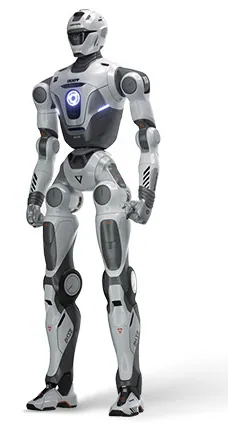 Image: EngineAI
EngineAI T800
EngineAI · China · 2025 · Humanoids
- Height: 173 cm
- Weight: 75 kg
- Degrees of freedom (total): 29
- Runtime per charge: 4.5 hrs
- Research, Entertainment/robot combat, Industry
Unitree H1-2
Unitree Robotics · China · 2024 · Humanoids
- Height: 178 cm
- Weight: 70 kg
- Degrees of freedom (total): 27
- Runtime per charge: 2 hrs
- Research, AI workloads, Manipulation