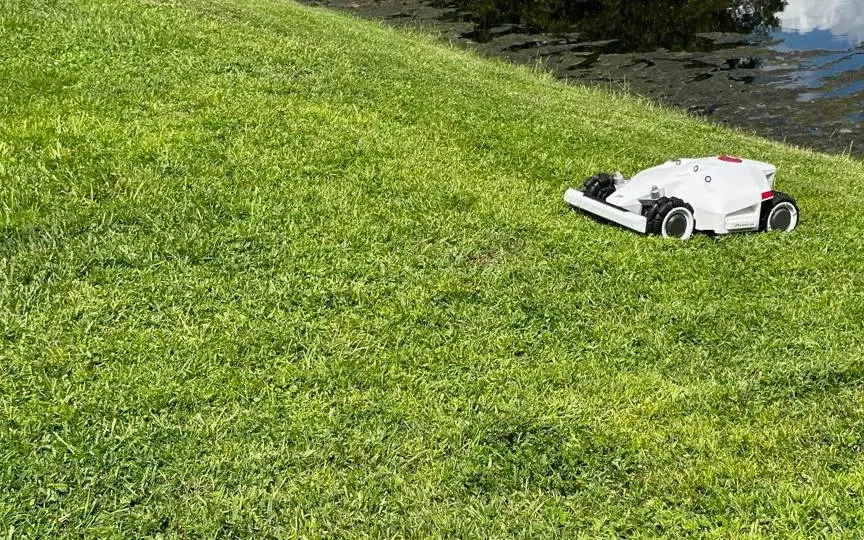
- Wire-free robotic mowers navigate via RTK satellite positioning, an AI camera or LiDAR laser; many 2026 models combine several technologies.
- RTK needs correction data: from your own station (Husqvarna EPOS RS1: up to 100 m radius, €309) or via network RTK over the internet.
- Trees and buildings block satellite signals; for angled gardens, LiDAR or combined systems are more robust.
- Cellular data is often included: Husqvarna up to 10 years, Mammotion 3 years (then €49.90/year), Gardena sense permanently free.
- Price examples: Gardena smart SILENO sense around €1,000, Worx Landroid Vision S250 €1,199, Husqvarna 410VE NERA €3,149 MSRP.
A robotic lawn mower without a boundary wire saves you the most tedious part of setup: instead of burying a wire along every lawn edge, you define the mowing area virtually, usually in an app, by steering the robot along the boundary once. How well this works depends on how the mower finds its way around the garden. Three technologies have become established: satellite-based RTK, a camera with AI image recognition (vision) and LiDAR, meaning laser scanning. Many current models combine two or all three.
This guide explains how a wire-free robotic lawn mower works, which technology suits which garden, what to look for when buying and what matters in day-to-day operation, from mowing frequency and winter storage to data usage.
How does a robotic lawn mower without a boundary wire work?
A conventional robotic mower recognizes the edge of the lawn by the signal from a wire. A wire-free robotic mower needs its own sense of where it is and what is around it. There are three approaches:
- RTK (satellite positioning with correction data): The robot receives signals from navigation satellites such as GPS, GLONASS and Galileo. Because standard GPS is only accurate to within a few meters, correction data is added, either from a reference station in the garden or via the internet (network RTK). This gives it centimeter-level accuracy.
- Camera and AI vision: A camera films the area in front of the robot, and software distinguishes lawn from flower bed, path or obstacle. A pure vision model works without satellites.
- LiDAR: A laser scanner scans the surroundings and creates a three-dimensional map. The robot uses it to determine its position based on house walls, trees or fences, even in the dark.
During setup, you usually drive the robot around the lawn once via the app or let it detect the boundaries automatically. After that, it usually mows in straight lanes rather than at random.
What is RTK on a robotic lawn mower?
RTK stands for Real Time Kinematic. The principle: a fixed station with a known position receives the same satellite signals as the robot. From the difference between the measured and actual position, it calculates correction values and sends them to the mower in real time. This allows the mower to follow the lines you drew in the app to within centimeters.
There are two ways to get the correction data:
- Your own reference station or RTK antenna: It is mounted in the garden or on the house wall and needs power as well as a clear view of the sky. Husqvarna states a working radius of up to 100 meters for its EPOS RS1 reference station and sells it separately for €309. With Ecovacs, according to a report by GameStar, the small RTK antenna of the GOAT O600 RTK is set up on a ground spike about two meters from the house wall, not directly under trees.
- Network RTK: The correction data comes from a network of reference stations via the internet, over Wi-Fi or cellular. No separate antenna is needed. Segway Navimow says it offers network RTK at no extra charge for the X4, i2 AWD and H2 series, among others; availability can be checked by postal code. In April 2026, Mammotion made its iNavi network RTK service permanently free for models from model year 2025 and the 2026 NetRTK devices. Husqvarna also provides the correction data for EPOS via the Husqvarna Cloud at no additional cost and recommends its own reference station mainly when cellular or Wi-Fi coverage does not reach the entire lawn.
The weakness of RTK: Satellite signals are blocked by dense tree canopies, tall hedges and buildings. Accuracy drops in such corners. That's why many manufacturers supplement RTK with a camera or LiDAR.
Camera, LiDAR or RTK: Which technology suits which garden?
Camera navigation is particularly easy to set up. In Worx's Landroid Vision series, a full HD camera and AI software distinguish between lawn, edges and obstacles, and no boundary wire is needed. The smallest model, the Landroid Vision S250, is designed for up to 250 square meters. The downside: the camera needs clear transitions between the lawn and its surroundings. Where the lawn blends seamlessly into the neighbor's meadow, pure image recognition reaches its limits.
LiDAR works independently of satellites and daylight. For the A2, Dreame advertises a 3D LiDAR sensor with a range of up to 70 meters and a field of view of 360 by 59 degrees; according to Dreame, no base station or radio beacons are needed. Ecovacs cites higher costs and sensitivity to fog and heavy rain, because the laser is scattered, as disadvantages of LiDAR. On the other hand, the technology is well suited to angled, shaded gardens with many trees.
Combinations offset the weaknesses. Examples based on manufacturer specifications:
- Mammotion LUBA 3 AWD: combines 360-degree LiDAR, two cameras and network RTK; according to the manufacturer, the top model handles slopes of up to 80 percent.
- Segway Navimow H2 series: LiDAR, network RTK and image processing, unveiled at CES 2026, for up to 1,000 or 2,000 square meters.
- Gardena smart SILENO sense: GPS RTK plus AI-assisted optical detection, for 400 or 600 square meters.
- Ecovacs GOAT O600 RTK: RTK plus an AI camera for obstacle detection, for up to 600 square meters.
Which wire-free robotic mower suits which garden?
- Open lawns with a clear sky: This is where RTK plays to its strengths. Long straight lanes, precise boundaries, little effort.
- Gardens with many trees, hedges and areas close to the house: Pure RTK can run into problems here. LiDAR or a combination of RTK with a camera or LiDAR is better.
- Small, clearly defined lawns: A cheaper camera model or a simple RTK model is often enough.
- Large or steep properties: Look for all-wheel drive and a high rated slope capability. According to the manufacturer, the Segway Navimow X4 series is designed for up to 6,000 square meters and 84 percent slopes.
If your lawn is split into several areas, check how many zones the app can manage and whether the robot drives the connecting paths between them on its own.
What should you look for when buying?
- Choose the area realistically: The manufacturer's area rating usually applies to ideal conditions. Husqvarna points out that obstacles and narrow passages reduce actual performance. A buffer of a few hundred square meters doesn't hurt.
- Check the slope rating: Slopes are given in percent. 45 percent corresponds to around 24 degrees. Note that lower values often apply at lawn edges: for the Husqvarna Automower 410VE NERA, one retailer lists 30 percent on the lawn but only 25 percent at the edge.
- Edge mowing: Many robots leave a strip uncut along the edge. On the A2, Dreame shifts the cutting disc outward; according to the manufacturer, this leaves about 5 centimeters to the lawn edge. Very few gardens get by entirely without touch-ups with a trimmer.
- Reference station or network RTK: Network RTK saves installation but requires stable network coverage in the garden and a service in your region. Your own antenna also works without internet but needs a spot with a clear view of the sky and a power connection.
- Cellular and app: Check whether a 4G module is built in or has to be bought separately, and how long the data connection is free. The app should make it easy to manage zones, schedules, cutting height and no-go areas.
- Theft protection: PIN lock, an alarm when lifted and GPS tracking are important. Anker eufy, for example, describes a notification for the 4G module of its C15 as soon as the mower is moved or leaves the mowing zone, as well as location tracking in the app.
- Obstacle and animal detection: Cameras or LiDAR help detect toys, garden hoses and animals. No manufacturer guarantees 100 percent protection.
How much data does a robotic lawn mower use?
There is no universal figure, and most manufacturers don't give one. Husqvarna writes that usage depends on the model, the installation and the mowing schedule, and that models with an AI camera in a wire-free EPOS installation use significantly more data than simple models with a boundary wire.
The more important question is who pays for the data:
- Husqvarna: integrated eSIM; according to the manufacturer, Automower Connect is free and has no operating costs for up to 10 years, provided the cellular technology is supported in the respective market.
- Gardena smart SILENO sense: integrated SIM card with a permanently free cellular connection.
- Mammotion: For 2026 models such as the LUBA 3 AWD, three years of 4G data are included; after that, 12 months cost €49.90. The network RTK connection remains free, while remote live video is tied to the data plan.
- Anker eufy: The 4G module for the C15 costs €99 and includes two years of data.
So with these models, you don't need your own SIM card with a large data allowance. Do check, however, what it costs once the free period ends.
Maintenance: How often to mow, when to put it away for winter, what happens to the charging station?
How often should a robotic lawn mower mow? Husqvarna recommends mowing daily if possible, because then only a few millimeters are cut each time. The fine clippings stay on the lawn as mulch and fertilize it. How long the robot needs for this depends on the size of the area, its shape and obstacles.
Schedule mowing times so that the robot runs during the day. At night, hedgehogs and other wild animals are out and about. To protect them, some authorities have already imposed nighttime bans based on nature conservation law. The district of Gießen in Germany, for example, has prohibited operation from 30 minutes before sunset to 30 minutes after sunrise since May 2026. Your local authority can tell you whether such a rule applies where you live. This note is not a substitute for legal advice.
When should you put your robotic mower away for winter? There is no fixed date. Below about 10°C, grass grows more slowly, and below 5°C it barely grows at all. The last cut usually falls in mid to late November; the robot should go into winter storage before the first night frosts at the latest.
Here's how to proceed:
- Set the last cut to 3 to 4 centimeters and remove leaves.
- Clean the robot thoroughly, including the underside, blade disc and wheels; don't use a pressure washer.
- Fully charge the battery and switch the device off completely. Husqvarna specifies dry storage above 0°C; according to the manufacturer, newer Automower models don't need to be recharged over the winter, while older ones need recharging about every three months.
- Check the blades and replace them if necessary, install software updates and write down your PIN.
Does the charging station have to be removed in winter? If it stands unprotected outdoors, you should remove it together with the power supply, clean it and store it in a dry place. If it stays outside, the power supply must remain connected. For wire-free models, the same applies to a separate RTK antenna or reference station; follow the manufacturer's instructions here.
How much does a robotic lawn mower without a boundary wire cost?
The range is wide. Some documented examples from 2024 to 2026:
- Entry level: Gardena smart SILENO sense for 400 square meters at around €1,000 (600-square-meter version around €1,100), Segway Navimow i105E at €999 at launch, Worx Landroid Vision S250 at a list price of €1,199. Retailers sometimes offer entry-level models significantly cheaper, such as the Ecovacs GOAT O600 RTK for €499 in a promotion in October 2026.
- Mid-range: Segway Navimow i108E for up to 800 square meters at €1,299 at launch.
- High end: Dreame A2 at €2,799 MSRP at launch in 2025, now available for €999 according to ifun.de; Husqvarna Automower 410VE NERA at €3,149 MSRP.
Factor in accessories: a garage, replacement blades, a reference station if needed (Husqvarna EPOS RS1: €309) and data plans after the free period ends.
What about data protection with camera-equipped robotic mowers?
A robot with a camera inevitably films whatever is in front of it, and that can include neighbors, passersby or the sidewalk. For private cameras, the German consumer advice center (Verbraucherzentrale) points out that only your own property should be captured. Anyone who films people without consent or publishes recordings risks injunctions and damage claims; data protection authorities can impose fines. Whether and how these principles apply to a robotic mower whose camera mainly serves navigation must be assessed case by case. This section is not a substitute for legal advice.
Practical tips:
- Set up mowing zones so that the robot does not drive directly along the property line with the neighbor or the street.
- Check in the app whether images are only processed locally or transferred to the cloud, and switch off features such as live video or photo capture if needed.
- Read the manufacturer's privacy policy: where are the servers, and how long is data stored?
- Secure your account with a strong password and, if offered, two-factor authentication.
Conclusion
In 2026, a robotic lawn mower without a boundary wire is a genuine alternative to a wired model for most gardens. For open areas, an RTK model is often enough, ideally with free network RTK. In gardens with trees, hedges and tight corners, LiDAR or combinations of RTK, camera and LiDAR are the more robust choice. Pure camera models are suitable for small, clearly defined lawns.
When buying, look for realistic area and slope ratings, good edge mowing, an easy-to-use app, theft protection with GPS tracking and how long the cellular connection stays free. Let the robot mow during the day, put it away for winter before the first frost and set up the camera so that it only captures your own property.
How this guide was created
Bot Up Your Life does not test robotic lawn mowers itself. All model, area, slope and price information in this guide comes from manufacturer websites, press releases, retailer information and trade media, as of October 18, 2026. Retail prices fluctuate considerably and can change at any time; the manufacturer's current information is authoritative. Where manufacturers do not publish figures, such as for data usage, we point this out instead of estimating.
Frequently asked questions
How does a robotic lawn mower without a boundary wire work?
Instead of a wire, it uses satellite positioning with RTK correction data, a camera with AI image recognition or a LiDAR laser scanner, often a combination. You define the mowing boundaries once in the app.
What is RTK on a robotic lawn mower?
RTK (Real Time Kinematic) corrects the satellite position using data from a reference station with a known position. This gives the robot centimeter-level accuracy. The correction data comes from your own antenna in the garden or via network RTK over Wi-Fi or cellular.
How often should a robotic lawn mower mow?
Husqvarna recommends mowing daily if possible, because then only a few millimeters are cut and the fine clippings can stay on the lawn as fertilizer. Mow during the day; some authorities prohibit nighttime operation to protect hedgehogs.
When should you put a robotic mower away for winter, and does the charging station have to be removed?
Usually in mid to late November, before the first night frost at the latest: fully charge the battery, switch off the device, clean it and store it dry above 0°C. A charging station standing unprotected outdoors should be removed together with its power supply; if it stays outside, the power supply must remain connected.
How much data does a robotic lawn mower use?
Most manufacturers don't give a fixed figure; according to Husqvarna, models with an AI camera use significantly more than simple wired models. With many brands, the data connection is included, for example up to 10 years with Husqvarna, so you don't need your own SIM.
How much does a robotic lawn mower without a boundary wire cost?
Prices range from around €1,000, for example for the Gardena smart SILENO sense or the Navimow i105E at launch, to over €3,000 MSRP for the Husqvarna 410VE NERA. Retailers sometimes offer entry-level models on sale from around €500.
Sources
- Husqvarna: EPOS Referenzstation RS1 (husqvarna.com)
- Husqvarna: Mobilfunk und SIM-Karten für Automower (husqvarna.com)
- Husqvarna: Wie oft sollte ich meinen Automower mähen lassen? (husqvarna.com)
- Segway Navimow: Network RTK (navimow.com)
- Smarthomeassistent: Segway Navimow Lineup CES 2026 (smarthomeassistent.de)
- Notebookcheck: Navimow i105E und i108E ab 999 Euro (notebookcheck.com)
- Mammotion: LUBA 3 AWD (mammotion.com)
- Mammotion: 4G Service Guide (eu.mammotion.com)
- GIGA: Mammotion iNavi dauerhaft kostenlos (giga.de)
- Notebookcheck: Gardena smart SILENO sense mit SIM-Karte (notebookcheck.com)
- PCGH: Worx Landroid Vision S250, Listenpreis 1.199 Euro (pcgameshardware.de)
- PCtipp: Dreame lanciert Mähroboter A2 (pctipp.ch)
- ifun.de: Dreame A2 von 2.799 auf 999 Euro (ifun.de)
- Ecovacs: RTK vs. LiDAR Mähroboter (ecovacs.com)
- GameStar: Ecovacs GOAT O600 RTK (gamestar.de)
- tink: Husqvarna Automower 410VE NERA (tink.de)
- Anker eufy: 4G-Modul für Mähroboter C15 (anker.com)
- homeandsmart: Mähroboter winterfest machen (homeandsmart.de)
- Landkreis Gießen: Allgemeinverfügung Nachtbetriebsverbot Mähroboter (gemeinde-reiskirchen.de)
- Verbraucherzentrale: Mit Kameras nur das eigene Grundstück filmen (verbraucherzentrale.de)
Related robots
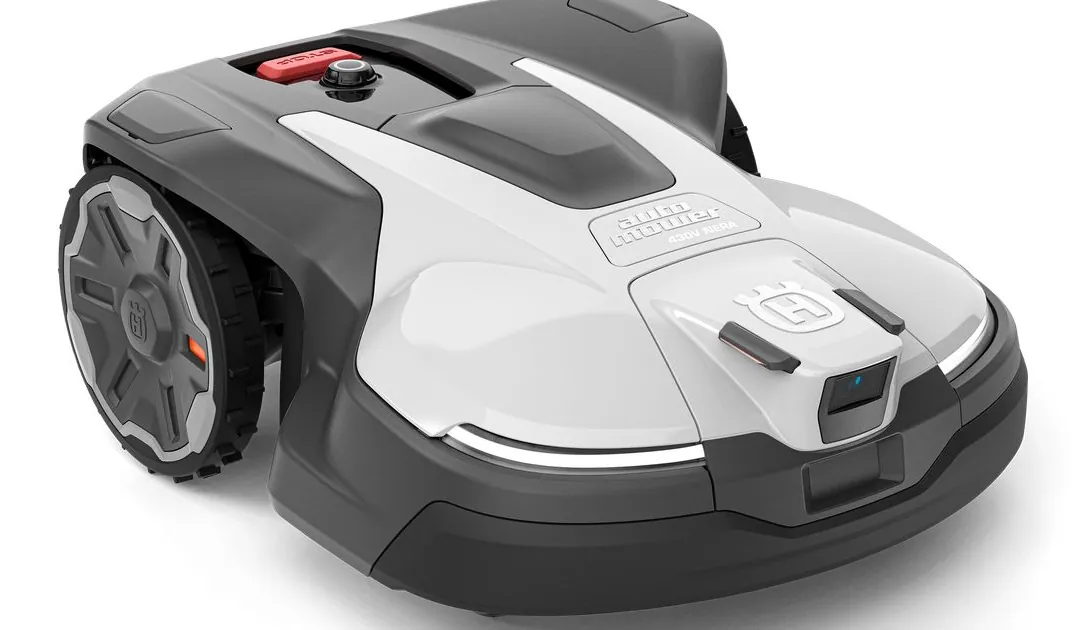 Image: Husqvarna
Husqvarna Automower 430V NERA
Husqvarna · Sweden · 2026 · Lawn mowers
- Noise level: 56 dB
- Battery: 5,000 mAh
- Weight: 15 kg
STIGA A 5000
STIGA · Italy · Lawn mowers
- Height: 30 cm
- Weight: 22.5 kg
- Runtime per charge: 4.3 hrs
- Lawns up to 7,000 m²
Lymow One Plus
Lymow · China · Lawn mowers
- Height: 31 cm
- Weight: 32 kg
- Runtime per charge: 12 hrs
- Top speed: 3.6 km/h
- Up to 7,000 m²/day
Mammotion LUBA mini 2 AWD 1000
Mammotion · China · 2026 · Lawn mowers
- Noise level: 55 dB
- Battery: 6,100 mAh
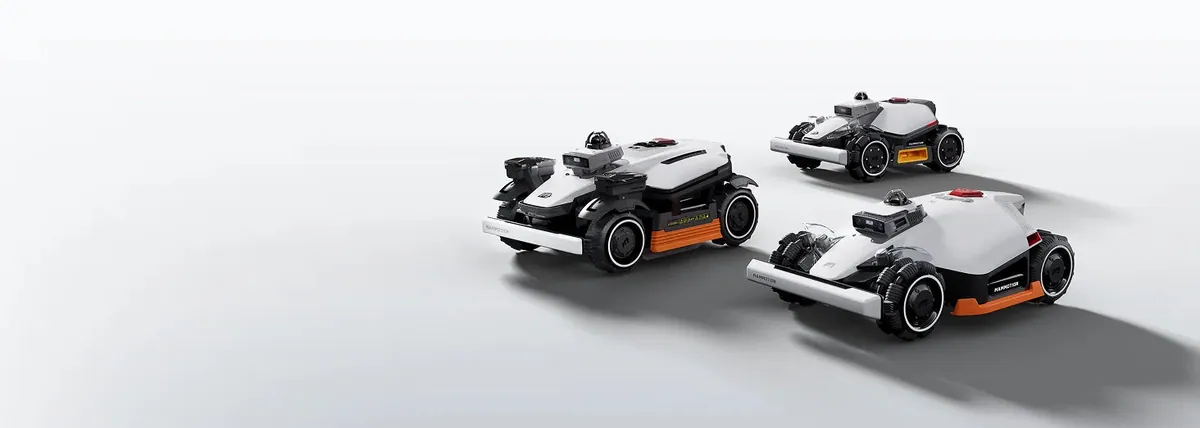 Image: Mammotion