
Our top pick in this ranking is the Piaggio gitamini from Piaggio Fast Forward: it leads the ranking on Payload, Speed, Runtime, Data coverage, Price. There are four types of delivery robots: sidewalk robots for the last mile, driverless road delivery vehicles, indoor robots for hotels and hospitals, and following robots for pedestrians. In Germany in 2026, it's mainly indoor models that can be freely bought or rented, while sidewalk robots only operate in approved pilot projects and are booked with the operator rather than bought.
- Top of our ranking: Piaggio gitamini.
- Sidewalk robots like Starship carry around 10 kg at max. 6 km/h and are operated by the provider, not sold to retailers.
- Hotel and hospital robots (Pudu, Keenon, Relay) offer lockable compartments, elevator integration and 9–12 h runtime; purchase, leasing or RaaS.
- Documented prices: indoor delivery robots from around $20,000, the gitamini following robot around €4,100, Chinese robovans under 100,000 yuan.
- Costs of $1 per delivery are manufacturer targets; in Germany, sidewalk robots need a temporary exemption permit.
- 24 models from 16 manufacturers compared, 21 of them currently available.
- Price range: $4,705 to $20,990 (prices as of October 18, 2026).
- Cheapest available model: Piaggio gitamini from €4,100.
Our picks at a glance
Our top pick: Piaggio gitamini
Bluetooth speaker, USB port. Leobotics lists China as country of origin.
Why it's on this list: ranked 1 of 10 in our ranking.
Strengths
- “Cheapest” award
- cheaper than 80% of the models in its category
Keep in mind
- –
Key specs
- Payload (kg): 9
- Speed (km/h): 9.4
- Runtime (h): 7
- Price: €4,100
- Data coverage: 54 %
Best value: Pudu T300
Industrial transport robot with 300 kg payload. Runtime 12 hrs empty, 6 hrs fully loaded. CE-MD and CE-RED certified (03/2025). Navigation without fixed paths.
Why it's on this list: ranked 2 of 10 in our ranking.
Strengths
- “Highest payload” award
- payload of 300 kg (more than 93% of the category)
Keep in mind
- more expensive than 100% of the models in its category
Key specs
- Payload (kg): 300
- Speed (km/h): 4.3
- Runtime (h): 6
- Price: $20,990
- Data coverage: 58 %
Budget pick: Pudu FlashBot Max
2-4 adjustable compartments, 10 kg per level each. IoT connection to elevators and turnstiles. Compartment access via password, phone number or NFC. Runtime 9 hrs, 538 x 534 x 1052 mm.
Why it's on this list: ranked 5 of 10 in our ranking.
Strengths
- runtime of 9 h (more than 67% of the category)
Keep in mind
- more expensive than 80% of the models in its category
Key specs
- Payload (kg): –
- Speed (km/h): 4.3
- Runtime (h): 9
- Price: $20,560
- Data coverage: 58 %
Best Payload: Kompai UHA
LiFePO4, 48 V. Max. 15 km/h. Incline 20%.
Why it's on this list: ranked 3 of 10 in our ranking.
Strengths
- payload of 250 kg (more than 86% of the category)
Keep in mind
- no price has been published
Key specs
- Payload (kg): 250
- Speed (km/h): 7.2
- Runtime (h): 3
- Price: –
- Data coverage: 46 %
How this ranking works
How this ranking works: only available or pre-orderable models are included. Each model is ranked within the list for each criterion (Payload, Speed, Runtime, Data coverage, Price); missing data counts as the worst value. We don't test robots ourselves but evaluate manufacturer and retailer information.
The specs are based on manufacturer and retailer information; every figure is backed by a source on the model's spec sheet.
Specs compared
| Model | Payload (kg) | Speed (km/h) | Runtime (h) | Data coverage (%) | Price |
|---|---|---|---|---|---|
| 1. Piaggio gitamini | 9 | 9.4 | 7 | 54 | €4,100 |
| 2. Pudu T300 | 300 | 4.3 | 6 | 58 | $20,990 |
| 3. Kompai UHA | 250 | 7.2 | 3 | 46 | – |
| 4. Keenon BUTLERBOT W3 | 20 | 2.9 | 12 | 58 | – |
| 5. Pudu FlashBot Max | – | 4.3 | 9 | 58 | $20,560 |
| 6. Pudu HolaBot | 60 | 4.3 | – | 54 | – |
| 7. Pudu SwiftBot | 35 | 4.3 | – | 42 | – |
| 8. Gausium Delivery X1 | 30 | 4.3 | – | 46 | – |
| 9. Pudu FlashBot | 30 | 4.3 | – | 46 | – |
| 10. Otsaw Camello | 20 | 5 | 3 | 42 | – |
Prices as of: October 18, 2026. Prices are manufacturer or retailer information and may vary.
The ranking: top 10
 Image: Piaggio Fast Forward
Piaggio gitamini
Piaggio Fast Forward · Delivery robots
- Height: 48 cm
- Weight: 12.7 kg
- Runtime per charge: 7 hrs
- Payload: 9 kg
- Robot that follows pedestrians, Shopping
Pudu T300
Pudu Robotics · China · 2025 · Delivery robots
- Height: 135 cm
- Weight: 65 kg
- Runtime per charge: 6 hrs
- Payload: 300 kg
- Industry, Bearings, Factory
Kompai UHA
Kompai Robotics · France · Delivery robots
- Height: 180 cm
- Weight: 350 kg
- Runtime per charge: 3 hrs
- Payload: 250 kg
- Factory logistics, Package delivery, R&D platform
Keenon BUTLERBOT W3
Keenon Robotics · China · Delivery robots
- Height: 108.1 cm
- Weight: 48 kg
- Runtime per charge: 12 hrs
- Payload: 20 kg
- Hotel
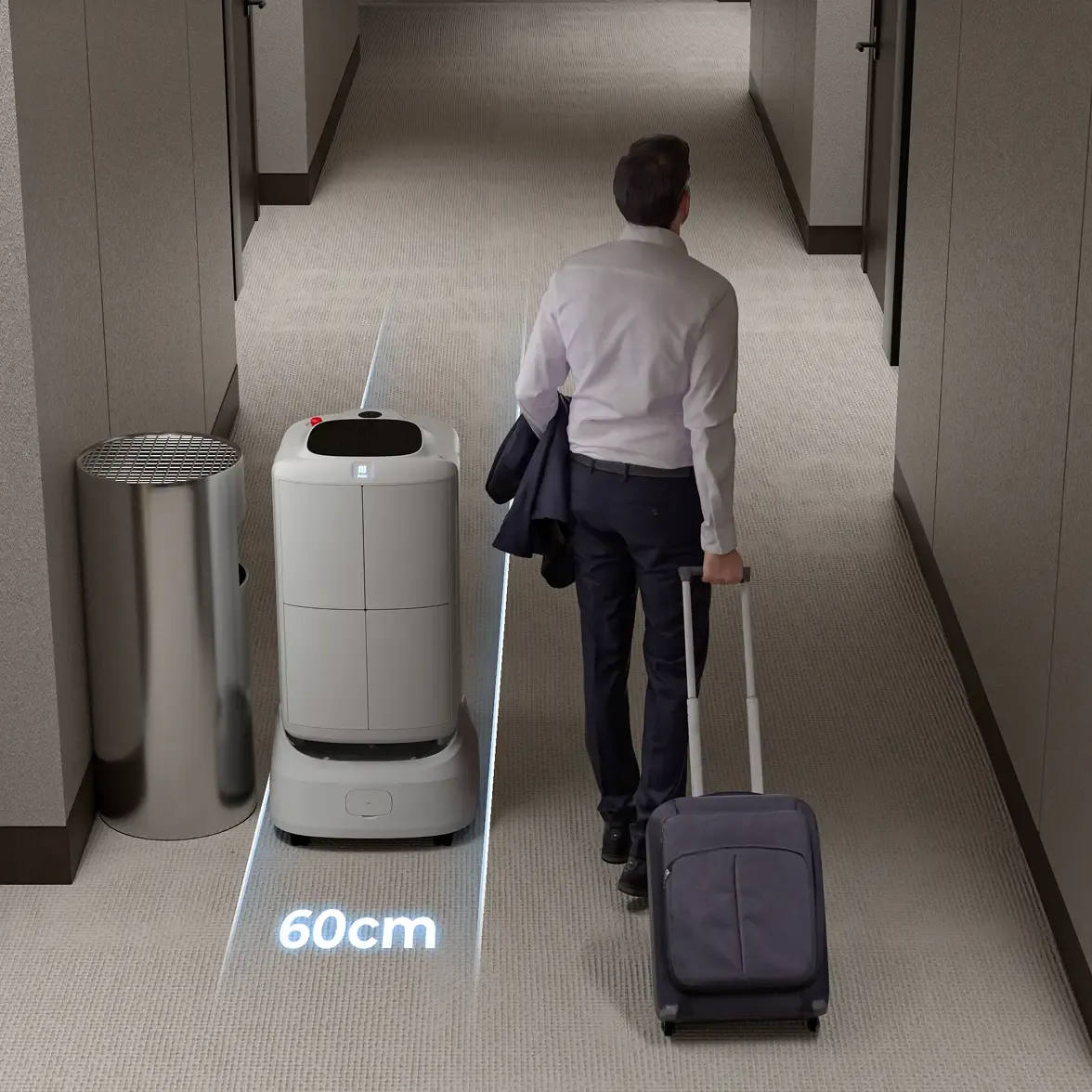 Image: Pudu Robotics
Pudu FlashBot Max
Pudu Robotics · China · 2025 · Delivery robots
- Height: 105.2 cm
- Weight: 60 kg
- Runtime per charge: 9 hrs
- Top speed: 4.3 km/h
- Multi-story buildings, Hotel room service, Semi-outdoor
Pudu HolaBot
Pudu Robotics · China · Delivery robots
- Height: 122.6 cm
- Weight: 60 kg
- Payload: 60 kg
- Top speed: 4.3 km/h
- Restaurant (dish return), Hospital, Office
Pudu SwiftBot
Pudu Robotics · China · Delivery robots
- Height: 128.1 cm
- Weight: 59 kg
- Payload: 35 kg
- Top speed: 4.3 km/h
- In-building delivery, Elevators/turnstiles
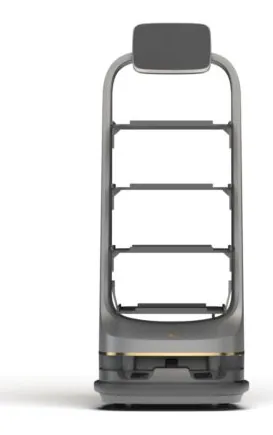 Image: Gausium
Gausium Delivery X1
Gausium · China · Delivery robots
- Height: 125 cm
- Weight: 35 kg
- Payload: 30 kg
- Top speed: 4.3 km/h
- Restaurant, Hospital, Hotel
Pudu FlashBot
Pudu Robotics · China · Delivery robots
- Height: 105 cm
- Weight: 55 kg
- Payload: 30 kg
- Top speed: 4.3 km/h
- In-building delivery, Hospital, Hotel
Otsaw Camello
Otsaw · Singapore · Delivery robots
- Runtime per charge: 3 hrs
- Payload: 20 kg
- Top speed: 5 km/h
- Last-mile package delivery, Logistics
Buying guide
A delivery robot isn't a single product but a whole family of devices. The six-wheeled robot on the sidewalk that brings groceries to your front door is one of them. So is the driverless delivery vehicle on the road, the hotel robot that brings towels to your room, and the small following robot that carries your shopping bag on a walk. If you want to buy or rent a delivery robot in 2026, you first need to clarify which type actually suits your use case. This guide explains the four groups, the most important providers and the buying criteria, from payload and range to theft protection. It also shows what delivery robots cost and which figures on the cost per delivery are documented. Bot Up Your Life doesn't evaluate robots hands-on: all figures come from manufacturers, authorities and specialist media, as of October 2026.
What types of delivery robots are there?
Four types can be distinguished on the market. They have little in common apart from the purpose of getting something from A to B.
- Sidewalk delivery robots: Small, mostly six-wheeled boxes that travel on the sidewalk at walking speed and deliver food, groceries or parcels on the last mile. Well-known providers include Starship Technologies, Cartken, Kiwibot and Serve Robotics.
- Road delivery vehicles: Driverless small vans with no room for occupants that drive on the road. The best-known Western example is the Nuro R2, but the segment has grown mainly in China, with providers such as Neolix and Zelos.
- Indoor delivery robots: Robots for hotels, hospitals, offices and factories. They travel along hallways, call elevators and deliver in lockable compartments. Key manufacturers include Pudu, Keenon, Gausium and Relay Robotics.
- Following robots for pedestrians: Personal cargo carriers that follow their owner. The best known is the Piaggio gitamini.
Drones such as those from Zipline are also delivery robots, but they form a separate category with its own aviation law. They are not the focus of this guide.
Sidewalk delivery robots: how does a Starship robot work?
The Starship robot is the best-known model. According to the technical specifications, it carries up to 10 kg, weighs about 35 kg itself and travels at a maximum of 6 km/h. The cargo compartment measures around 40 × 32 × 34 cm; the REWE Group states a volume of 32 liters for its robots in Hamburg. The customer orders via the app, the robot drives autonomously and only opens its lid when the recipient unlocks it in the app. If it gets stuck, Starship staff take over remotely.
The scale is now considerable. In April 2026, Starship reported more than 10 million autonomous deliveries with over 3,000 robots at around 300 locations in eight countries, including Germany, Switzerland, the UK, Finland, Estonia and the US. In Finland, according to Starship, the robots run year-round, handling up to 20 percent of the S Group's online grocery orders there.
Other providers have their own focus:
- Cartken: In Bielefeld, four Cartken robots deliver groceries of up to 20 kg in a permanently mounted compartment whose lid only opens with a code. The robots travel along pre-mapped routes through the residential neighborhood.
- Serve Robotics: According to an investor presentation from March 2026, the third generation travels at up to 11 mph (around 18 km/h), covers 48 miles (around 77 km) or 14 hours and is designed to work from -20 to +45 °C and in heavy rain. The cargo volume is around 57 liters. Serve has over 2,000 robots in operation, mainly for Uber Eats and DoorDash in the US.
- Kiwibot: The fourth generation came onto the market in 2021 with Segway as its manufacturing partner, featuring a weatherproof housing, cooling and a delivery radius of around one mile. Current technical spec sheets are hardly available publicly.
In Germany, sidewalk robots have so far been limited to pilot projects. REWE ended its Starship operation in Hamburg-Barmbek as planned in April 2026 after around six months and is evaluating the results.
Road delivery vehicles: what happened to Nuro and who delivers in China?
Road delivery vehicles play in a different league. According to our data, the Nuro R2 weighs around 1,150 kg, carries up to 190 kg and travels at up to 40 km/h. It trialed deliveries in the US with partners such as Domino's and Walmart. Important for anyone interested: Nuro has not pursued its own delivery business further. As specialist media reported in early 2026, the company licenses its driving software to automakers and platforms, for example for robotaxis with Uber and Lucid. Nuro is currently not building its own delivery vehicles as a product.
The real market is in China. According to a government portal of Henan province from August 2025, the fourth-generation Neolix X3 costs under 100,000 yuan (around $14,000), carries 600 to 800 parcels and travels at 15 to 20 km/h. At that time, Neolix had over 7,500 vehicles in 280 cities. Other providers such as Zelos also operate large robovan fleets. In Europe, such vehicles are not yet freely available for purchase and would need approval as an autonomous motor vehicle.
Hotel delivery robots, hospital robots and following robots: what can they do?
For most businesses in Germany, this is the most realistic way to get started. Indoor robots operate on private premises, don't need a road permit and are already available on the regular market today.
- Hotel delivery robots: The Keenon BUTLERBOT W3 has up to four individually lockable compartments, carries 20 kg in total (10 kg per level), runs for up to 12 hours and rides elevators on its own. The Pudu FlashBot Max offers 2 to 4 adjustable compartments with 10 kg each, up to 9 hours of runtime and access via password, phone number or NFC. According to retailers, it can be linked to elevators from KONE and OTIS and is also suitable for semi-open areas such as gardens or pool areas.
- Hospital robots: With the RelayRX, Relay Robotics offers a delivery robot for hospitals with a 41-liter compartment and complete handover documentation (chain of custody). According to the manufacturer, more than 15 hospital systems were customers in 2023 and over one million deliveries had been completed. The Pudu HolaBot (60 kg, 120 liters) and Gausium Delivery X1 (30 kg) are also offered for hospitals.
- Industry and warehouses: The Pudu T300 carries up to 300 kg and, according to the manufacturer, is CE-certified. It runs for 12 hours empty and 6 hours fully loaded.
Following robots for pedestrians: The gitamini from Piaggio Fast Forward isn't a delivery robot but a personal companion. It follows its owner using cameras and sensors after being paired at the push of a button. According to the manufacturer, it carries up to 20 pounds (around 9 kg), travels at up to 6 mph (just under 10 km/h) and lasts around 7 hours or 34 km. It weighs 12.7 kg, charges in about two hours and is designed for temperatures from about -12 to +43 °C. The product information doesn't mention a lock or theft protection. It makes sense for people who do a lot of their shopping on foot, for example in the city or in old age, and don't want to carry heavy loads. The payload isn't enough for larger weekly grocery runs.
Who is a delivery robot worth it for?
The answer depends heavily on the type:
- Hotels: A hotel delivery robot is worth it above all in buildings with several floors and many room service orders when staff are in short supply. Elevators that can be controlled and sufficiently wide hallways are prerequisites.
- Hospitals and care facilities: Medications, lab samples and supplies can be transported with full traceability. This saves nursing staff walking time.
- Supermarkets, delivery services and municipalities: Sidewalk robots are only worth it with a high order density within a small radius. In Germany, this is currently only possible as an approved pilot project with a provider such as Starship or Cartken, not by buying individual devices.
- Industry and warehouses: Transport robots with a high payload replace internal trips with carts or forklifts.
- Private individuals: For them, practically only a following robot like the gitamini is an option. A sidewalk delivery robot for private use is not available to buy.
Buy a delivery robot or use it as a service?
With delivery robots, there are two fundamentally different business models.
Purchase, leasing or Robots-as-a-Service (RaaS): Retailers such as RobotLAB offer indoor robots from Pudu and Keenon for purchase, leasing or as a rental model. When you buy, you pay for the device once and take care of maintenance and software yourself. With the RaaS model, you pay a monthly fee that usually includes software updates, service and replacement. Providers generally don't publish specific monthly rates; they are only available on request.
Delivery as a service: Sidewalk robots are practically never sold. Starship, Serve and Cartken operate the fleet themselves and bill per delivery or through partnerships with retailers and platforms. So the retailer isn't buying a robot but delivery capacity. Road delivery vehicles, on the other hand, are sold to logistics companies in China, according to Neolix with a down payment of as little as around 800 yuan.
Rule of thumb: if you can keep a robot busy on your own premises long-term, weigh purchase against RaaS. If you want to deliver on public roads, negotiate with an operator.
The key buying criteria for delivery robots
1. Payload and compartment volume. The range is huge. Following robots carry around 9 kg, sidewalk robots 10 to 20 kg (Starship 10 kg, Cartken in Bielefeld up to 20 kg), hotel robots usually 20 kg spread over several compartments, hospital and transport robots 30 to 60 kg, and industrial models up to 300 kg. Pay attention not only to the total weight but to the load per compartment and the volume. A 32-liter compartment is enough for a small grocery order but not for a crate of drinks. That's exactly why drink crates and frozen goods were excluded from the REWE project in Hamburg.
2. Range and runtime. Sidewalk robots usually deliver within a radius of 1.5 to 2 km around a warehouse or store. Starship states around 12 hours of driving time, Serve Gen3 up to 14 hours. Indoor robots manage 9 to 12 hours. Charging time is important too: according to retailers, the Keenon W3 needs 6.5 hours, the FlashBot Max 4 hours. Check whether the robot returns to the charging station on its own and whether the battery can be swapped, as with the Pudu HolaBot.
3. Speed. In Europe, sidewalk robots travel at walking speed of around 6 km/h at most. Indoor robots are deliberately slow at 0.5 to 1.2 m/s (around 2 to 4.3 km/h). Road vehicles reach 15 to 40 km/h. More speed means more deliveries per hour, but also stricter rules.
4. Weather resistance. Weather plays no role for indoor robots, but it does for semi-open areas such as terraces. Outdoors, the climate is decisive. In Finland, Starship runs with winter tires, adapted motor control and snow detection, but retailers take the robots offline in heavy snowfall. Serve advertises its third generation for -20 to +45 °C and heavy rain. The gitamini is designed for about -12 to +43 °C. Ask about the protection rating (IP class) and temperature range, which many spec sheets don't state.
5. Theft and tamper protection. Reputable delivery robots have lockable compartments that only open via app, PIN, phone number or NFC. According to Yle, Starship robots have 16 cameras and microphones, sound an alarm when lifted or kicked and can be located in real time. Vandalism does occur, but according to the S Group, it is rare in Finland. In hospitals, the documented chain of custody matters more than the lock alone.
6. Navigation and building integration. For hotels and hospitals, elevator integration is the most important criterion. Clarify whether your elevator manufacturer is supported and whether doors, turnstiles and barriers can be controlled. Also check the minimum passage width: the Keenon W3 needs 70 cm, the Gausium Delivery X1 65 cm according to the manufacturer.
7. Operation and remote monitoring. Sidewalk robots are backed by a control center that intervenes when problems arise. Ask who handles this, how quickly they respond and what it costs.
How much does a delivery robot cost?
In this market, prices are often only available on request. Documented examples:
- Following robots: The Piaggio gitamini is listed at around €4,100 in our database. In the US, Piaggio Fast Forward sells the special-edition Grogu gitamini for $2,875.
- Hotel and building delivery: According to retailers, the Pudu FlashBot Max costs from around $20,000, and just over $20,500 in our data. According to RobotLAB, the Keenon BUTLERBOT W3 starts at $29,600.
- Industrial transport: The Pudu T300 costs around $21,000.
- Road delivery vehicle: The Neolix X3 costs under 100,000 yuan in China.
- Sidewalk robots: No public purchase price, as the providers operate the robots themselves.
How much does a robot delivery cost? Reliable, independent figures are hard to come by. The available figures come from the providers themselves:
- In April 2026, Starship stated that autonomous delivery is $3 to $4 cheaper than delivery by courier. The long-term goal is around $1 per delivery.
- Serve Robotics puts the cost of a courier delivery in the US at $8 to $10 and expects under $1 with a large fleet. This is a forecast, not an achieved value.
- At its US launch in 2021, Kiwibot charged $1.99 per delivery.
- In the Bielefeld pilot project, delivery is currently free for users.
For the calculation, utilization is what counts: a robot that only makes a few trips a day is more expensive than any other solution.
Are delivery robots allowed in Germany?
We cover the legal situation in detail in our guide to the law on delivery robots. The key points in brief:
- Sidewalk: There is no dedicated vehicle category. Every deployment requires a temporary exemption permit from the responsible authority, as in Hamburg and Bielefeld.
- Road: Germany's Autonomous Driving Act of 2021 allows driverless vehicles in approved operating areas, but isn't aimed at sidewalk robots.
- Indoor: Hotel and hospital robots are mainly subject to machinery law with CE marking and occupational safety rules. From January 20, 2027, the new EU Machinery Regulation applies.
- Data privacy: Robots with cameras capture people. Purpose, storage period and pixelation belong in a data protection concept; in hospitals, coordination with the data protection officer is also required.
Care, maintenance and running costs
A delivery robot isn't a device you buy once and forget about. Plan for these ongoing items:
- Software and maps: Updates, map maintenance after renovations and, where applicable, cloud fees. Usually included with RaaS, often as a service contract when you buy.
- Battery: Lithium batteries age. Ask about the replacement price and warranty period.
- Cleaning and hygiene: Clean compartments regularly, following the hygiene plan in hospitals. According to its spec sheet, the Pudu FlashBot offers UV disinfection in the compartment.
- Wear parts: Tires, wheels, sensors and cameras, plus winter tires for outdoor robots.
- Integration: Elevator integration, Wi-Fi coverage and charging stations incur one-time costs that are not included in the device price.
- Insurance: Even without a legal obligation, business liability insurance should cover the use of the robot.
Common mistakes when buying a delivery robot
- Choosing the wrong type: A serving robot for a restaurant isn't a room service robot. Without lockable compartments and elevator integration, it's of little use in a hotel.
- Not checking elevators: Many projects fail because the existing elevator can't be connected or retrofitting is expensive.
- Only looking at payload: Compartment volume, load per compartment and passage width are often more important in everyday use.
- Confusing runtime with operating time: Charging times of 4 to 6.5 hours determine whether a device can handle shift operation.
- Taking manufacturer forecasts as facts: Costs of $1 per delivery are targets, not guarantees.
- Underestimating the legal situation: If you want to operate outdoors in Germany, you need an exemption permit. Without it, even the best robot is useless.
- Forgetting running costs: Maintenance, software, battery and integration belong in every calculation.
- Not involving staff: Without training and clear processes, the robot ends up standing in the corner.
Conclusion: which delivery robot is right in 2026?
There's no single delivery robot. For hotels, hospitals and businesses, indoor models from Pudu, Keenon, Gausium or Relay are the most mature choice: freely available, with no road permit needed, and available to buy, lease or rent. Sidewalk delivery robots such as Starship are already part of everyday life in Finland or the US, but in Germany they remain approved pilot projects for the time being, which you don't buy but book with the operator. Road delivery vehicles are a Chinese market, while Nuro has shifted to licensing. For private individuals, following robots like the gitamini are the only real way in. If you honestly weigh payload, compartment volume, runtime, weather resistance, theft protection and building integration against your own use case, you'll find the right model in the data ranking above.
Frequently asked questions
How much does a delivery robot cost?
According to retailers, indoor delivery robots for hotels and buildings cost from around $20,000, and the Keenon BUTLERBOT W3 from $29,600. The Piaggio gitamini following robot costs around €4,100. Sidewalk robots such as Starship are not sold but booked as a delivery service.
Can you buy a delivery robot?
Indoor robots from Pudu, Keenon or Gausium can be bought, leased or rented as Robots-as-a-Service. Sidewalk delivery robots are operated by the providers themselves; retailers buy delivery capacity from them rather than devices.
Are delivery robots allowed in Germany?
On sidewalks, only with a temporary exemption permit, because German vehicle law has no dedicated category for them. Indoor robots on private premises don't need a road permit, but must comply with machinery and occupational safety law.
Where do delivery robots operate in Germany?
In Bielefeld-Lohmannshof, Cartken robots have been delivering groceries in a publicly funded pilot project since January 2026. REWE ended its Starship pilot operation in Hamburg-Barmbek as planned in April 2026 after around six months.
How much can a Starship robot carry?
A Starship robot carries up to 10 kg, weighs around 35 kg itself and travels at a maximum of 6 km/h. REWE states a compartment volume of 32 liters for the Hamburg robots.
What does a hotel delivery robot do?
It brings orders, towels or parcels to guest rooms on its own, rides the elevator and only opens its locked compartments via PIN, phone number or NFC. Models such as the Keenon W3 or Pudu FlashBot Max carry up to 20 kg in up to four compartments.
Which robots are used in hospitals?
Hospital robots such as the RelayRX transport medications, samples and supplies in locked compartments with a documented chain of custody. The Pudu HolaBot and Gausium Delivery X1 are also offered for hospitals.
How much does a robot delivery cost?
There are no independent figures yet. Starship states that it is $3 to $4 cheaper than a courier, and Serve Robotics expects under $1 per delivery with a large fleet; both are manufacturer claims.
Buying guide sources
- Starship Technologies: Autonomous delivery moves into the mainstream as Starship passes 10 million deliveries (starship.xyz)
- Starship Technologies: One million deliveries in Finland (starship.xyz)
- Wevolver: Starship Robot – Tech Specs (wevolver.com)
- REWE Group: REWE Lieferbot 2.0 launches with a larger range (rewe-group.com)
- Lebensmittel Praxis: Rewe beendet Testbetrieb mit Lieferrobotern in Hamburg (lebensmittelpraxis.de)
- heise online: „Teutobots“ – Autonome Roboter transportieren Waren in Bielefeld (heise.de)
- Serve Robotics: Investor Presentation (SEC 8-K) (boardroomalpha.com)
- Robotics 24/7: Kiwibot launches version 4.0 of its food-delivery robot (robotics247.com)
- Automotive World: Nuro's AV pivot paying off as Uber deployment nears (automotiveworld.com)
- Henan Provincial Government: Autonomous driving paves way for smarter logistics in China (english.henan.gov.cn)
- RobotLAB: Keenon W3 (BUTLERBOT W3) (robotlab.com)
- RobotLAB: Pudu FlashBot Max (robotlab.com)
- Relay Robotics: Relay announces next generation of delivery robots for hospitals (relayrobotics.com)
- Piaggio Fast Forward: Shop (gitamini, gitaplus) (piaggiofastforward.com)
- Yle News: Delivery robots vandalised in Pieksämäki (yle.fi)
Related guide: Delivery Robots in 2026: What's Allowed? The Legal Situation in Germany and Worldwide