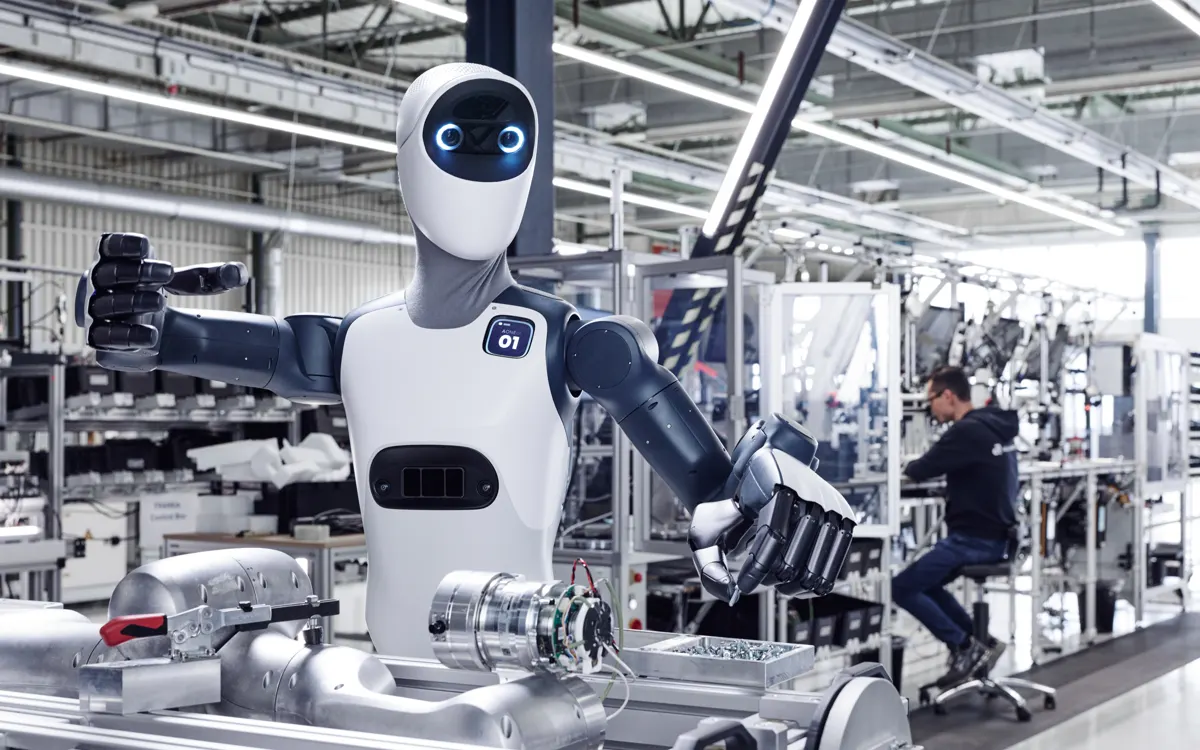
Our top pick in this ranking is the 1X NEO from 1X Technologies: it leads the ranking on Degrees of freedom, Runtime, Payload, Data coverage, Price. Humanoid robots can be bought in 2026, mainly as research, education and industrial platforms: from the Unitree R1 for just under €10,000 and the Unitree G1 from around €23,000 net up to industrial models costing over €100,000. Real household humanoids such as the 1X NEO are so far only available for pre-order and are expected to reach Europe in 2027 at the earliest.
- Top of our ranking: 1X NEO.
- Base versions (e.g., Unitree G1 Basic) usually have no SDK – for programming, teaching and research, you need the EDU version.
- Prices: Unitree R1 just under €10,000, G1 Basic €23,000 net to €27,370 gross, G1 EDU from approx. €43,500, industrial models $30,000–$135,000.
- Tesla Optimus can't be ordered; the 1X NEO costs $20,000 or $499/month, with deliveries starting in the US.
- Check before buying: EU retailer, warranty (often only 8–18 months), 19% import VAT plus customs, data privacy, risk assessment.
- 107 models from 59 manufacturers compared, 59 of them currently available.
- Price range: $1,400 to $200,000 (prices as of October 18, 2026).
- Cheapest available model: Noetix Bumi from $1,400.
Our picks at a glance
Our top pick: 1X NEO
Lift capacity >68 kg, carry 25 kg. As quiet as 22 dB. Soft body made of 3D-lattice polymer. Hayward (CA) factory opened May 1, 2026. Connectivity: WiFi, Bluetooth, 5G. Initial autonomy estimated at 60-70% by industry sources. Lifts 70 kg, carries 25 kg, 8 kg arm payload. Fast charging: 6 min per 1 h runtime (charging time derived). 22 dB operating noise. Soft polymer shell, washable suit. WiFi, Bluetooth, 5G. Walking 1.4 m/s, hand speed 8 m/s. Delivery from 2026 (alpha-bionic). Charging time: 6 min per hour of operation, 800 W charger. 5G, Wi-Fi, Bluetooth. Teleoperation by '1X Experts' as backup. 10,000 pre-orders in 5 days (manufacturer claim).
Why it's on this list: ranked 1 of 10 in our ranking.
Strengths
- “Best data coverage” award
- 75 degrees of freedom (more than 95% of the category)
- payload of 25 kg (more than 84% of the category)
- cheaper than 88% of the models in its category
Keep in mind
- –
Key specs
- Degrees of freedom: 75
- Runtime (h): 4
- Payload (kg): 25
- Price: $20,000
- Data coverage: 96 %
Best value: Kepler K2 Bumblebee
15 kg per arm. Up to 8 h operation after 1 h charging. Near-zero power draw when idle. In small-batch production (5th generation). >80% core hardware in-house.
Why it's on this list: ranked 2 of 10 in our ranking.
Strengths
- payload of 30 kg (more than 92% of the category)
- runtime of 8 h (more than 90% of the category)
- cheaper than 75% of the models in its category
Keep in mind
- –
Key specs
- Degrees of freedom: 52
- Runtime (h): 8
- Payload (kg): 30
- Price: $30,000
- Data coverage: 75 %
Budget pick: Unitree H2
7 DoF per arm, 3 DoF waist, 2 DoF head. Arm payload nominal ~7 kg, peak ~15 kg. Bionic face. WiFi 6, Bluetooth 5.2. 31 DoF: 6/leg, 7/arm, 3 waist, 2 head. Arm payload 7 kg nominal / 15 kg peak. Quick-swap battery 15 Ah, 75.6 V. Warranty 8 months (EDU 12). Dimensions 1820×456×218 mm. WiFi 6, Bluetooth 5.2. 30+ DoF. Battery approx. 15 Ah / 0.972 kWh. NVIDIA GR00T reference platform (H2 Plus). RadarScore 2/10.
Why it's on this list: ranked 9 of 10 in our ranking.
Strengths
- cheaper than 77% of the models in its category
Keep in mind
- –
Key specs
- Degrees of freedom: 31
- Runtime (h): 3
- Payload (kg): 7
- Price: $29,900
- Data coverage: 83 %
Best Degrees of freedom: Unitree H2 Plus
NVIDIA research bundle. Hardware of the NVIDIA Isaac GR00T reference humanoid. Tactile-sensing hands. Aerospace-grade materials.
Why it's on this list: ranked 3 of 10 in our ranking.
Strengths
- 75 degrees of freedom (more than 95% of the category)
Keep in mind
- more expensive than 80% of the models in its category
Key specs
- Degrees of freedom: 75
- Runtime (h): 3
- Payload (kg): 15
- Price: $95,000
- Data coverage: 92 %
How this ranking works
How this ranking works: only available or pre-orderable models are included. Each model is ranked within the list for each criterion (Degrees of freedom, Runtime, Payload, Data coverage, Price); missing data counts as the worst value. We don't test robots ourselves but evaluate manufacturer and retailer information.
The specs are based on manufacturer and retailer information; every figure is backed by a source on the model's spec sheet.
Specs compared
| Model | Degrees of freedom | Runtime (h) | Payload (kg) | Data coverage (%) | Price |
|---|---|---|---|---|---|
| 1. 1X NEO | 75 | 4 | 25 | 96 | $20,000 |
| 2. Kepler K2 Bumblebee | 52 | 8 | 30 | 75 | $30,000 |
| 3. Unitree H2 Plus | 75 | 3 | 15 | 92 | $95,000 |
| 4. EngineAI T800 | 29 | 4.5 | 20 | 88 | $37,500 |
| 5. Fourier GR-3 | 55 | 3 | 15 | 83 | $80,000 |
| 6. UBTECH Walker C1 | 53 | 3 | 5 | 83 | $79,000 |
| 7. AgiBot G2 Max | 50 | 4 | 20 | 79 | $135,000 |
| 8. MagicLab MagicBot X1 | 42 | 4 | 20 | 75 | $75,000 |
| 9. Unitree H2 | 31 | 3 | 7 | 83 | $29,900 |
| 10. UBTECH Walker S2 | 52 | 2 | 15 | 83 | $80,000 |
Prices as of: October 18, 2026. Prices are manufacturer or retailer information and may vary.
The ranking: top 10
 Image: 1X Technologies
1X NEO
1X Technologies · Norway · 2025 · Humanoids
- Height: 165 cm
- Weight: 29.9 kg
- Degrees of freedom (total): 75
- Runtime per charge: 4 hrs
- Household, Housework, Conversation/assistance
Kepler K2 Bumblebee
Kepler · China · 2025 · Humanoids
- Height: 175 cm
- Weight: 75 kg
- Degrees of freedom (total): 52
- Runtime per charge: 8 hrs
- Manufacturing, Logistics, Hazardous environments
Unitree H2 Plus
Unitree Robotics · China · 2026 · Humanoids
- Height: 182 cm
- Weight: 70 kg
- Degrees of freedom (total): 75
- Runtime per charge: 3 hrs
- Research, AI/robotics R&D, Universities
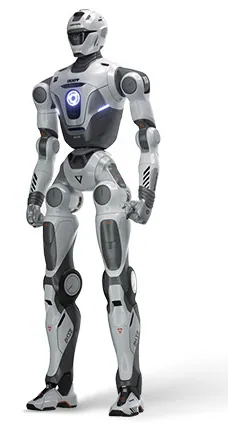 Image: EngineAI
EngineAI T800
EngineAI · China · 2025 · Humanoids
- Height: 173 cm
- Weight: 75 kg
- Degrees of freedom (total): 29
- Runtime per charge: 4.5 hrs
- Research, Entertainment/robot combat, Industry
Fourier GR-3
Fourier · China · 2025 · Humanoids
- Height: 165 cm
- Weight: 71 kg
- Degrees of freedom (total): 55
- Runtime per charge: 3 hrs
- Care, Healthcare, Education
UBTECH Walker C1
UBTECH Robotics · China · Humanoids
- Height: 165 cm
- Weight: 50 kg
- Degrees of freedom (total): 53
- Runtime per charge: 3 hrs
- Commercial service, Trade shows/exhibitions, Hospitality
AgiBot G2 Max
AgiBot · China · Humanoids
- Height: 179 cm
- Weight: 185 kg
- Degrees of freedom (total): 50
- Runtime per charge: 4 hrs
- Industry, Logistics, Manufacturing
MagicLab MagicBot X1
MagicLab · China · Humanoids
- Height: 170 cm
- Weight: 65 kg
- Degrees of freedom (total): 42
- Runtime per charge: 4 hrs
- Commercial service, Health, Household
Unitree H2
Unitree Robotics · China · 2025 · Humanoids
- Height: 182 cm
- Weight: 70 kg
- Degrees of freedom (total): 31
- Runtime per charge: 3 hrs
- Research, Industry, Education
UBTECH Walker S2
UBTECH Robotics · China · 2025 · Humanoids
- Height: 176 cm
- Weight: 70 kg
- Degrees of freedom (total): 52
- Runtime per charge: 2 hrs
- Automotive manufacturing, Smart factory, Logistics
Buying guide
Buying a humanoid robot is possible in 2026, but it's different from buying a robot vacuum: if you order today, you'll almost always get a platform for research, education, demonstrations or pilot projects in industry. The classic household helper that empties the dishwasher on its own is so far only available for pre-order and initially intended for customers in the US. At the same time, prices are falling fast, German specialist retailers and even large electronics stores are listing the first models, and with NEURA Robotics and Agile Robots, companies from Germany are also working on their own humanoids.
This buying guide explains who a humanoid robot is worth it for, how research platforms, household humanoids and industrial humanoids differ, which buying criteria really count and what costs you'll face after the purchase. We don't put the robots through hands-on trials ourselves; we evaluate manufacturer specifications, retailer information and reports from reputable specialist media. As of October 18, 2026.
Who is a humanoid robot worth it for?
The honest answer: in 2026, mainly for organizations that want to develop, showcase or trial something with the robot. The market reflects this too. According to market research firm Counterpoint Research, more than 22,000 humanoid robots were shipped worldwide in the first half of 2026. Over 60 percent of them went into entertainment, demonstrations, research and data generation, only 13 percent into manufacturing and 5 percent into warehouse logistics.
- Universities, schools and research labs: They need an open platform on which students and researchers can program walking, grasping and AI models. Here, humanoid robots are already a useful tool today.
- Companies with automation plans: If you're planning pilot projects in logistics, manufacturing or inspection, you can use an industrial humanoid to check whether tasks can be automated in existing environments built for humans. BMW, for example, had a Figure 02 work in body-in-white production at its US plant in Spartanburg for ten months and is trialing Hexagon's wheeled AEON at its Leipzig plant.
- Trade shows, showrooms, hotels and reception areas: Smaller service humanoids are enough for attracting attention, greeting visitors and giving simple information. Renting is often more economical than buying here.
- Private individuals: For tech enthusiasts and developers, there are small models such as the Unitree R1 or the Unitree G1. But they won't take any work off your hands at home. If you want a real household helper, you'll still have to wait in 2026.
A representative Bitkom survey from September 2026 shows how great the interest is: 42 percent of people in Germany expect humanoid household robots to be part of everyday life within a few years, and 28 percent would spend €5,000 or more on one.
Research platform, household humanoid or industrial humanoid: the types at a glance
Humanoid robots look similar, but are built for completely different tasks. Before you compare prices, you should choose the right category.
Research and education platforms are designed for programmability. What matters is an open software development kit (SDK), support for the robotics framework ROS 2, simulation models and an active developer community. Typical examples are the EDU versions of the Unitree G1 and H2, as well as the Unitree H2 Plus, which NVIDIA presented in June 2026 as the hardware for its GR00T reference platform for research. Strength and endurance are secondary; runtimes of two to three hours are common.
Household humanoids are meant to be light, quiet and safe for living alongside people. The best-known example is the 1X NEO: just under 30 kilograms, with a soft shell and, according to the manufacturer, only 22 decibels loud. Tasks it can't yet handle on its own can be taken over by a manufacturer employee via remote control. No open SDK for your own programming is known.
Industrial humanoids are designed for shift operation, payload and robustness. Key features are swappable batteries, protection against dust and splashing water, integration with factory software and documented reference customers. Examples include the UBTECH Walker S2, which according to the manufacturer swaps its own battery in around three minutes, the Kepler K2 Bumblebee with up to eight hours of runtime, and the AgiBot G2 Max, which moves on wheels instead of legs.
Service and interaction humanoids such as the UBTECH Walker C1 or the Fourier GR-3 rely on speech, facial expressions and a friendly appearance. They're intended for reception, trade shows, education or social care, but carry little.
A special form is humanoids on wheels. They don't walk on two legs, so they tip over less often and are often more practical on level factory floors. They can't manage stairs.
The key buying criteria
A humanoid robot is an investment in the five- to six-figure range. You should clarify these criteria before ordering, with concrete guideline values from manufacturer specifications.
- Degrees of freedom and hands: The number of degrees of freedom (movable axes) determines how finely a robot moves and grasps. According to the manufacturer, entry-level models such as the base version of the Unitree G1 have 23 degrees of freedom and no gripping hands. The EDU variants reach up to 43 with optional hands. Top models such as the 1X NEO or the Unitree H2 Plus reach 75. For grasping tasks, the hands are decisive: check whether they're included in the price, how many fingers they have and whether they have tactile sensors.
- Runtime and battery: Two to four hours is common. According to the manufacturer, the Unitree G1 runs for about two hours on a 9,000 mAh swappable battery, the 1X NEO for about four hours. For industrial use, swappable batteries or autonomous battery swapping are what count, so that the robot can last a full shift.
- Payload: Small research models often carry only a few kilograms; for the G1, the retailer RBTX states 2 to 3 kilograms. Industrial models manage 15 to 30 kilograms. Pay attention to whether the figure refers to one arm or both arms, and whether it's nominal or a short-term peak.
- Software, SDK and AI: Clarify whether an open SDK is included, whether ROS 2 is supported and whether simulation models are available. According to Unitree and several retailers, the base versions of the Unitree G1 have no developer access. For the G1 Base, MediaMarkt explicitly points out that programming isn't possible. For the 4NE1, NEURA states a Python and C++ SDK as well as a ROS 2 interface.
- Autonomy: Ask specifically which tasks the robot performs on its own and which require remote control by humans. Many demo videos show remote-controlled or pre-programmed sequences.
- Warranty and service: Manufacturer warranties are short. Unitree gives eight months for the G1 and 18 months for the G1 EDU. The German retailer RBTX generally states one year on the robot and six months on the battery for its G1 variants. Ask about repair times, spare parts and loan devices.
- Size and weight: A 1.30-meter G1 weighing around 35 kilograms is still manageable in the lab. Human-sized models weighing 70 kilograms or more need a lifting frame, space and trained staff.
- Connectivity and data privacy: Wi-Fi, Bluetooth and in some cases 5G are standard. Clarify which data goes to the manufacturer's servers and whether the cloud connection can be switched off.
How much does a humanoid robot cost?
The price range is enormous. Important: manufacturers' US dollar prices almost always exclude taxes and shipping, and many industrial models are only available on request.
Entry level under €10,000: The small Unitree R1 is around 1.20 meters tall and, according to the manufacturer, runs for about an hour. The specialist retailer Funduino listed it in September 2026 for €9,996, with delivery from the end of December 2026. In spring 2026, the JD.com platform Joybuy accepted pre-orders for €4,900. According to specialist reports, the standard version doesn't have functional fingers.
Compact research class, around €18,000 to €75,000: According to the manufacturer, the Unitree G1 costs from $13,500 excluding taxes and shipping. In September 2026, German retailers charged €23,000 net (Terra Robotics), €27,275.89 (Reichelt) and €27,370 gross (Funduino and QUADRUPED Robotics via the MediaMarkt marketplace) for the G1 Basic. Joybuy offered it for €17,884 at times. According to Borncity, the EDU versions with developer access cost from €43,500, and the Ultimate variants with hands up to €73,900. According to a retailer overview, the NEURA 4NE1 Mini from Germany can be reserved from €19,999 net.
Household humanoids at around $20,000: According to the manufacturer, the 1X NEO costs $20,000 in the Early Access program or $499 a month as a subscription, with a $200 reservation. There's no euro price yet.
Human-sized research and industrial models, from around $30,000: Unitree states $29,900 for the base version of the H2. Kepler quoted from $30,000 for the K2 Bumblebee. UBTECH's Walker C1 is listed at €67,682 at Terra Robotics. Specialist databases quote around $95,000 for the Unitree H2 Plus. NEURA charges €98,000 net per unit for the 4NE1 Gen 3.5 for up to 19 units and €60,000 for 20 units or more. The AgiBot G2 Max is listed at $135,000.
On top of the purchase price come hands, computing modules, spare batteries, a lifting frame, software licenses, training and maintenance. If you only need one appearance, you can rent: for events, service providers rent out a G1 with an operator from about €1,500 net.
Price check on the most searched-for models:
- Unitree G1 price: from $13,500 according to the manufacturer; in Germany, the base version usually costs around €23,000 net or around €27,300 gross. For programming, you need an EDU version from about €43,500.
- Tesla Optimus price: There isn't one. As of October 2026, Tesla has published neither orders nor pre-orders nor an official price. The quarterly report of July 22, 2026, stated that the first production lines in Fremont were being installed. The frequently cited $20,000 to $30,000 is a long-term goal of Elon Musk's. He held out the prospect of sales to private customers for the end of 2027.
- 1X NEO price: $20,000 or $499 a month. Delivery is planned initially in the US for 2026; according to the manufacturer, other markets are set to follow from 2027.
When will humanoid household robots arrive?
The 1X NEO is the first model explicitly offered for private households with a price and delivery date. In May 2026, 1X opened its own factory in Hayward, California. Whether devices are already in private customers' homes could not be independently confirmed as of mid-October 2026. For Europe, 1X names 2027. Tesla is targeting private customers for the end of 2027.
Realistically, that means: based on manufacturers' current plans, a humanoid household robot will be available in Germany in 2027 at the earliest. The first devices won't be able to do everything on their own. With NEO, remote control by manufacturer employees is explicitly part of the concept. Before pre-ordering, check whether the deposit is refundable and when a delivery date for your country will be set.
Who builds humanoid robots in Germany?
Almost all available humanoids come from China. According to Counterpoint, the five largest manufacturers together shipped 86 percent of all humanoids in the first half of 2026, all of them from China. But there are German providers too:
- NEURA Robotics from Metzingen is accepting reservations for the 4NE1 Gen 3.5, with delivery planned for the end of 2026; the €100 deposit is refundable until the purchase contract is signed. There's also the smaller 4NE1 Mini for education and research.
- Agile Robots from Munich has presented the Agile ONE, an industrial humanoid that is 1.74 meters tall, weighs 69 kilograms and has a 20-kilogram payload. According to the manufacturer, series production was set to begin in Bavaria in early 2026.
- Research institutions such as the German Aerospace Center (TORO) and the Karlsruhe Institute of Technology (ARMAR) develop their own humanoids, which are not sold.
Where can you buy humanoid robots in Germany, and what applies to imports?
In addition to buying directly from the manufacturer, there are now several retailers based in Germany or the EU:
- RBTX, the robotics marketplace of igus from Cologne, carries the Unitree G1 in over 20 variants, from Basic to EDU versions with different hands. Prices are available on request.
- Reichelt Elektronik carries Unitree humanoids such as the G1, with all prices including VAT.
- Generation Robotics, a French specialist retailer for research robotics with a focus on ROS, offers Unitree humanoids such as the G1 and H1 and ships internationally.
- Terra Robotics, Funduino and QUADRUPED Robotics are other German retailers, some offering leasing. Terra states a minimum leasing term of three years.
- Platforms such as Joybuy or AliExpress are often cheaper, but deliver base versions without an SDK and offer less service.
For companies and universities, a specialist retailer is usually the better choice. They help you select the right variant, offer training and commissioning and are your direct point of contact in the event of a warranty claim.
Imports, customs and warranty for robots from China. For direct imports from China, 19 percent import VAT and, where applicable, customs duty are added to the value of the goods plus shipping. For goods classified as industrial robots (commodity code 8479 50 00), the third-country customs duty rate according to the EU customs tariff is 1.7 percent. How a humanoid robot is classified in an individual case is up to customs. For larger orders, a binding tariff information ruling is worthwhile.
More important than customs is service. You can only assert the statutory warranty under German law against your seller. If they're based in China, that becomes difficult. For products sold to consumers, the EU General Product Safety Regulation also requires a responsible economic operator based in the EU. Also clarify whether spare parts for joints and motors are stocked in Europe and how long repairs take.
Pay attention to radio approvals too. Since August 1, 2025, mandatory cybersecurity requirements have applied to connected radio equipment in the EU. Request the EU declaration of conformity before buying.
EDU version or base version: what do schools and universities need?
With Unitree, the difference is fundamental. The base versions of the G1 and H2 are intended for demonstrations and remote control; you can't install your own programs. According to the manufacturer, the EDU versions offer support for your own development, optional computing modules with NVIDIA Jetson Orin, optional hands and additional joints. With the G1 EDU, the warranty is also extended from eight to 18 months.
For teaching and research, you should ask specifically about the following points:
- Is the SDK enabled for high-level and low-level control?
- Are there simulation models, for example for NVIDIA Isaac Sim or MuJoCo?
- Are ROS 2 and common programming languages such as Python and C++ supported?
- Which hand suits the research question, and can it be retrofitted?
- Are there education discounts, training courses and teaching materials?
If you're researching AI for robots, keep an eye on NVIDIA's GR00T reference platform. It bundles hardware based on the Unitree H2 Plus with open foundation models and simulation tools. According to NVIDIA, deliveries are set to begin at the end of 2026.
Safety, law and data privacy
A biped weighing 35 to 70 kilograms can fall over in the event of a power failure or software error. That's why the following applies to operation:
- Risk assessment: Companies and universities must prepare one before the first deployment. A CE mark doesn't replace it.
- Machinery Regulation: From January 20, 2027, the new Machinery Regulation applies in the EU, which for the first time explicitly addresses self-learning and connected machines. If you substantially modify a robot with your own software, you can become a manufacturer yourself.
- Standards: A dedicated safety standard for dynamically stable industrial robots, ISO 25785-1, is still at the draft stage.
- Product liability: From December 9, 2026, a new Product Liability Act applies in Germany, which also covers software and AI defects.
Data privacy also deserves attention. Humanoid robots have cameras, microphones and often LiDAR. In October 2025, security researchers reported that a Unitree G1 could be taken over via a Bluetooth vulnerability and regularly transmitted telemetry data to servers in China. Operate the robot on a separate network, involve your data protection officer and works council early on, and install security updates promptly. This overview does not replace legal advice.
Care, maintenance and running costs
After the purchase, a humanoid robot incurs ongoing costs that you should plan for:
- Batteries: Swappable batteries are wear parts. RBTX grants only a six-month warranty on the G1 battery. A second battery significantly extends operating time.
- Joints and motors: Falls and continuous use put strain on the mechanics. Ask about prices for replacement joints and service packages.
- Software and updates: On many models, updates come over the network. Clarify whether software packages, AI features or remote control services cost extra.
- Staff and training: Someone has to operate and maintain the robot and keep things safe during demonstrations.
- Subscription models and leasing: The 1X NEO is planned at $499 a month, and German retailers offer leasing for companies. For one-off events, renting is often cheaper.
Budget a fixed annual amount for spare parts, service and software, and get the terms in writing before you buy.
Common mistakes when buying
- Buying a base version for development: Unitree's inexpensive base versions can't be freely programmed. For teaching and research, you need the EDU version.
- Only comparing the list price: Hands, computing modules, batteries, shipping and taxes can double the price.
- Taking demo videos at face value: Many clips show remote-controlled or pre-programmed sequences. Ask about the actual degree of autonomy.
- Importing without an EU retailer: Warranty, spare parts and statutory guarantees become difficult with direct imports.
- Underestimating delivery times: "Available" doesn't mean "ready to ship". Some models have delivery times until the end of 2026 or later.
- Waiting for a Tesla Optimus that can't be ordered: Plan with models that actually exist.
- Forgetting safety and data privacy: Risk assessment, network separation and a data protection review belong before the first deployment.
- Expecting household benefits: Research models such as the G1 or R1 don't do housework.
Conclusion: buying a humanoid robot in 2026 is worth it for pioneers
In 2026, a humanoid robot is a tool for research, teaching, industrial pilots and demonstrations, not a finished household appliance. If you want to program, you need an EDU version with an open SDK. If you want to run trials in a factory, pay attention to runtime, payload, battery swapping and references. If you're waiting for a household helper, you'll probably have to be patient until 2027 in Germany.
Our advice: define the purpose precisely, calculate with total costs rather than list prices, buy through a retailer in the EU if possible, and clarify software, safety and data privacy before you sign. The ranking above shows which models come out on top according to our data.
Frequently asked questions
How much does a humanoid robot cost?
The entry point is just under €10,000 for the small Unitree R1. At German retailers, the base version of the Unitree G1 costs around €23,000 net to €27,370 gross, while human-sized research and industrial models range from about $30,000 to over $130,000.
Where can you buy a humanoid robot?
In Germany, RBTX, Reichelt, Terra Robotics and Funduino, among others, carry Unitree humanoids, and the G1 is also available via the MediaMarkt marketplace. The French specialist retailer Generation Robotics also ships to Germany, and NEURA Robotics sells the 4NE1 directly via reservation.
How much does the Unitree G1 cost?
Unitree states from $13,500 excluding taxes and shipping. German retailers charge around €23,000 net or €27,300 gross for the G1 Basic; according to Borncity, the EDU versions with developer access start at €43,500.
How much does the Tesla Optimus cost?
There's no official price, and as of October 2026, Optimus can neither be ordered nor pre-ordered. The frequently cited $20,000 to $30,000 is a long-term goal of Elon Musk's.
How much does the 1X NEO cost?
According to 1X, NEO costs $20,000 in the Early Access program or $499 a month as a subscription, with a $200 reservation. Deliveries start in the US, with Europe set to follow from 2027.
When will humanoid household robots arrive?
The 1X NEO is set to go to its first customers in the US in 2026; for Europe, 1X names 2027. Tesla is targeting private customers by the end of 2027; in Germany, no household humanoid is available yet in 2026.
Who builds humanoid robots in Germany?
NEURA Robotics from Metzingen offers the 4NE1 Gen 3.5 (€98,000 net, delivery planned for the end of 2026) and the 4NE1 Mini. Agile Robots from Munich has presented the Agile ONE industrial humanoid, and there are also research robots from the DLR and KIT.
What's the difference between the base and EDU versions?
Base versions, for example from Unitree, are intended for demonstrations and remote control and can't be freely programmed. EDU versions offer SDK access, optional computing modules and hands, and, for the G1, an 18-month instead of 8-month warranty.
Buying guide sources
- Unitree: G1 technische Daten, Preis und Garantie (unitree.com)
- RBTX (igus): Unitree G1 Variantenübersicht mit Garantie und SDK (a.storyblok.com)
- MonsterDealz: Händlerpreise humanoider Roboter in Deutschland (monsterdealz.de)
- Notebookcheck: Unitree G1 Preise bei Joybuy und Reichelt (notebookcheck.com)
- MediaMarkt-Marktplatz: Unitree G1 Base (Verkäufer QUADRUPED Robotics) (mediamarkt.de)
- Terra Robotics: Unitree G1 Basic, Preis und Leasing (terra-robotics.de)
- Borncity: Unitree G1 weltweit bestellbar, EDU-Preise (borncity.com)
- t3n: Unitree R1 bei AliExpress und Joybuy (t3n.de)
- TravTeks: 1X NEO, Fabrik Hayward und Preise (travteks.com)
- BotInfo: Tesla Optimus nicht bestellbar, Status laut Tesla-Berichten (botinfo.ai)
- NEURA Robotics: 4NE1 Gen 3.5 Reservierung, Preise und SDK (neura-robotics.com)
- Zolltarifnummern.de: 8479 50 00 Industrieroboter, Drittlandszollsatz (zolltarifnummern.de)
- Counterpoint Research: Humanoiden-Auslieferungen H1 2026 (counterpointresearch.com)
- Bitkom: Zahlungsbereitschaft für humanoide Haushaltsroboter (bitkom.org)
- Help Net Security: Sicherheitslücke und Telemetrie beim Unitree G1 (helpnetsecurity.com)
Related guide: Humanoid Robots and the Law in 2026: What Applies Now?