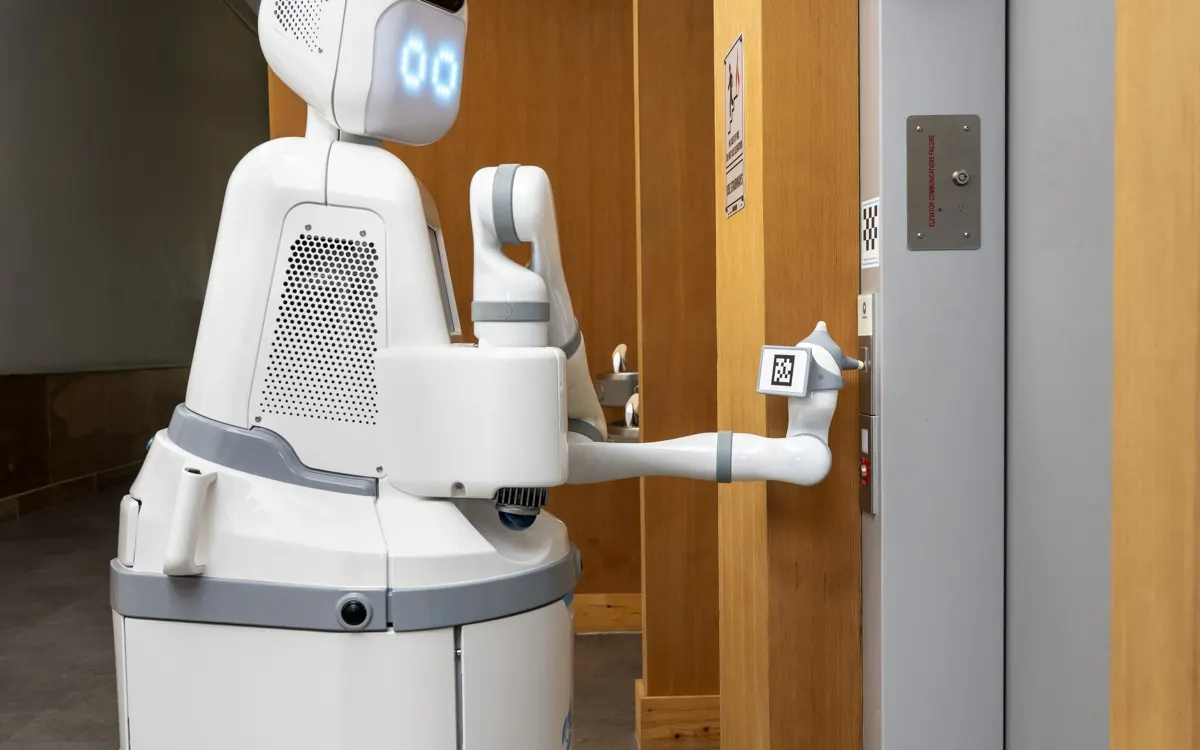
Our top pick in this ranking is the Pudu BellaBot Pro from Pudu Robotics: it leads the ranking on Payload, Runtime, Data coverage, Price. In 2026, a serving robot is worth it above all for restaurants and hotels with long distances, sufficiently wide aisles (usually 55 to 80 cm) and lots of dishes to carry and clear. According to retailers, entry-level models cost around €8,000 to €10,000 net, leasing is possible from about €270 a month, and a trial period in your own dining room should come before buying.
- Top of our ranking: Pudu BellaBot Pro.
- The narrowest aisle during service is what counts: depending on the model, serving robots need a passage width of 55 to 80 cm.
- 3 to 4 trays with around 10 kg each are typical; for clearing heavy platters, a total payload of 40 kg makes sense.
- Purchase from around €8,900 net, leasing from approx. €270/month, rental for trying one out – prices vary greatly by retailer.
- The EU Machinery Regulation applies from Jan. 20, 2027; include the robot in your risk assessment and clarify how camera data is handled.
- 17 models from 11 manufacturers compared, 15 of them currently available.
- Price range: $25,476 to $25,476 (prices as of October 18, 2026).
- Cheapest available model: Aldebaran Plato from €22,200.
Our picks at a glance
Our top pick: Pudu BellaBot Pro
Swappable battery. Food recognition. Floor projection at intersections. Cat design.
Why it's on this list: ranked 1 of 10 in our ranking.
Strengths
- runtime of 11 h (more than 75% of the category)
Keep in mind
- no price has been published
Key specs
- Payload (kg): –
- Runtime (h): 11
- Price: –
- Data coverage: 54 %
Best value: Aldebaran Plato
Mapping in 60 minutes. Touchscreen. 3 trays.
Why it's on this list: ranked 5 of 10 in our ranking.
Strengths
- cheaper than 73% of the models in its category
Keep in mind
- –
Key specs
- Payload (kg): 30
- Runtime (h): –
- Price: €22,200
- Data coverage: 46 %
Best Payload: CSJBot Wenda
HD touchscreen. Multi-tier trays. Breathing color LEDs.
Why it's on this list: ranked 6 of 10 in our ranking.
Strengths
- payload of 50 kg (more than 89% of the category)
Keep in mind
- no price has been published
- data coverage is still thin (29% of core specs documented)
Key specs
- Payload (kg): 50
- Runtime (h): –
- Price: –
- Data coverage: 29 %
How this ranking works
How this ranking works: only available or pre-orderable models are included. Each model is ranked within the list for each criterion (Payload, Runtime, Data coverage, Price); missing data counts as the worst value. We don't test robots ourselves but evaluate manufacturer and retailer information.
The specs are based on manufacturer and retailer information; every figure is backed by a source on the model's spec sheet.
Specs compared
| Model | Payload (kg) | Runtime (h) | Data coverage (%) | Price |
|---|---|---|---|---|
| 1. Pudu BellaBot Pro | – | 11 | 54 | – |
| 2. Pudu BellaBot | 40 | – | 46 | – |
| 3. Keenon T8 | – | 16 | 42 | – |
| 4. Reeman Deligo | 30 | 12 | 46 | – |
| 5. Aldebaran Plato | 30 | – | 46 | €22,200 |
| 6. CSJBot Wenda | 50 | – | 29 | – |
| 7. AI Robotics UGO Runner | – | 4 | 50 | – |
| 8. Pudu KettyBot | 30 | – | 50 | – |
| 9. OrionStar LuckiBot | 40 | – | 42 | – |
| 10. UBTECH CadeBot | 40 | – | 33 | – |
Prices as of: October 18, 2026. Prices are manufacturer or retailer information and may vary.
The ranking: top 10
Pudu BellaBot Pro
Pudu Robotics · China · Service
- Height: 129 cm
- Weight: 55 kg
- Runtime per charge: 11 hrs
- Top speed: 4.3 km/h
- Restaurant, Office, Shopping mall
Pudu BellaBot
Pudu Robotics · China · Service
- Height: 129 cm
- Weight: 57 kg
- Payload: 40 kg
- Top speed: 4.3 km/h
- Restaurant, Shopping mall, Health
Keenon T8
Keenon Robotics · China · Service
- Height: 109.8 cm
- Weight: 35 kg
- Runtime per charge: 16 hrs
- Restaurant
Reeman Deligo
Reeman · China · Service
- Height: 130 cm
- Weight: 48.5 kg
- Runtime per charge: 12 hrs
- Payload: 30 kg
- Restaurant, Hotel, Office
Aldebaran Plato
Aldebaran · France · Service
- Height: 111.3 cm
- Weight: 53 kg
- Payload: 30 kg
- Restaurant, Catering, Hotel
 Image: AI Robotics
AI Robotics UGO Runner
AI Robotics · France · Service
- Height: 140 cm
- Weight: 60 kg
- Runtime per charge: 4 hrs
- Top speed: 5.4 km/h
- Restaurant, Hotel, Cafeteria
Pudu KettyBot
Pudu Robotics · China · Service
- Height: 112 cm
- Weight: 38 kg
- Payload: 30 kg
- Top speed: 4.3 km/h
- Restaurant, Retail, Reception
 Image: OrionStar
OrionStar LuckiBot
OrionStar · China · Service
- Height: 132 cm
- Weight: 47 kg
- Payload: 40 kg
- Restaurant, Reception, Events
Buying guide
In restaurants and hotels, a serving robot is no longer a toy but a work tool with a clear job: it carries plates, drinks and dirty dishes so that staff walk less and have more time for guests. Whether it pays off, however, depends less on the design than on your floor plan, your workflows and whether you buy, lease or rent. This buying guide shows what matters when choosing a service robot for the hospitality industry in 2026, which prices are documented on the market and which new legal obligations apply from January 2027.
Who is a serving robot worth it for in hospitality?
A serving robot is worth it above all where there's a lot of carrying and a lot of walking. According to industry reports, a large share of working time in table service is spent carrying food and drinks. The robot takes over exactly these trips while the server stays at the table, gives advice and handles payment.
Well suited are:
- Restaurants with a large dining room and long distances between the kitchen and the tables, such as chain restaurants, destination restaurants or brewpubs.
- Businesses with a lot of returns, i.e. with heavy platters, steak boards or large amounts of dishes to clear.
- Hotels that want to cover the breakfast room, banquets and room service. For room service, however, you need a model with a closed compartment and elevator integration.
- Cafeterias, care facilities and hospitals, where trays are distributed along fixed routes.
- Inclusive businesses: in a pilot project in the German state of Hesse, a robot helps employees with physical disabilities serve guests.
Less suitable are small, cramped rooms with steps, narrow aisles and many obstacles. Businesses in the pilot project in the Main-Kinzig district cited exactly this point as the most common reason why deployment is difficult. A restaurant on several levels without an elevator also benefits only partially, because serving robots can't climb stairs. A restaurant owner from Bayreuth reported that his robot therefore only covers about two-thirds of the floor space.
What are service robots used for? Serving, clearing, greeting and delivery
In the hospitality industry, the term service robot covers four typical tasks:
- Serving: The kitchen loads the trays and selects the table numbers on the display, and the robot goes to the tables one after another. Guests or staff take the plates off. Models such as the Keenon T9 Pro use radar to detect when something has been removed.
- Clearing: The robot collects dishes and brings them to the dishwashing area. For clearing, the total payload counts more than the number of trays.
- Greeting and advertising: Models with a large screen, such as the Pudu KettyBot (18.5-inch display), welcome guests, lead them to their table or display offers.
- Delivery in hotels: Enclosed delivery robots such as the Pudu FlashBot or the Keenon W3 bring towels, drinks or food to guest rooms. They have lockable compartments and, with the right technology, can call elevators.
A new class is semi-humanoid service robots with gripper arms, such as the Pudu FlashBot Arm. According to the manufacturer, it can call elevators and open doors, but it is significantly more expensive and is aimed more at hotels and office buildings than at the classic restaurant.
The key buying criteria: what matters with a serving robot?
The following criteria determine whether a robot works reliably in your business. The guideline values come from manufacturer specifications and retailer spec sheets.
Number of trays and payload
Three to four open trays with around 10 kg each are typical. According to the manufacturer, the Pudu BellaBot Pro carries up to 10 kg per level on four trays, the Keenon T9 40 kg in total. More compact models such as the Keenon T8 manage 20 kg, split into 5, 5 and 10 kg. Rule of thumb: for serving only, 20 to 30 kg is enough; for clearing heavy platters, it should be 40 kg. Tray size also matters: will your largest plate or steak board fit on it? Adjustable levels help with tall glasses and carafes.
Navigation: LiDAR, camera or ceiling markers
Modern serving robots map the room with lasers (LiDAR) and cameras, often as a combination of laser SLAM and visual SLAM. The Pudu BellaBot uses both plus 3D sensors for obstacle detection. Older or cheaper variants rely on markers on the ceiling. One retailer lists the Keenon T5 with both marker and laser navigation. Ceiling markers also work well in very crowded rooms, but they have to be installed and don't suit every ceiling. Laser navigation requires no modifications, but can reach its limits in rooms with many mirrors, glass or very high ceilings. Ask for a trial period in your own dining room before you buy.
Aisle width
The minimum passage width is the most important exclusion criterion. The values are usually between 55 and 80 cm:
- Keenon T8: 55 cm
- Keenon T10: 58.5 cm
- Pudu FlashBot (hotel delivery): 60 cm
- Pudu BellaBot Pro: 65 cm
- Keenon T9: 70 cm
- Keenon T5: 70 cm with markers, 80 cm with laser navigation
Measure your narrowest aisle when all the chairs are occupied, not in an empty room. Allow a buffer of 10 to 15 cm so that the robot doesn't keep stopping.
Battery and shift operation
Manufacturer specifications range from about 8 hours (Keenon T10) to around 10 hours without load (BellaBot Pro) and 18 hours (Keenon T9). Charging usually takes 4 to 6 hours. For lunch and dinner service with a break in between, almost any model will do. For hotels with breakfast, banquets and a bar, or for around-the-clock operation, a swappable battery makes sense, as offered by the BellaBot. Also make sure that the robot returns to its charging station on its own.
Incline, flooring and thresholds
Most serving robots are built for indoor use only. For many Keenon models, retailers state a maximum incline of 5 degrees. Check carpet edges, thresholds and ramps to the terrace in advance.
Elevator integration
Crucial for hotels and multi-story businesses: the robot doesn't call the elevator by pressing a button, but via a wireless or cloud connection. For the FlashBot, Pudu offers a cloud solution that requires no elevator modifications for certain manufacturers, as well as its own hardware module for other systems. Plan the coordination with your elevator company and the additional costs early on. LG also states elevator use for the CLOi ServeBot.
Operation, call system and fleet
Check how staff call the robot: on the display, via a wristband button or by voice command. If you want to use several robots, you need fleet management. For the CLOi ServeBot, LG states coordination with up to 20 other devices. Integration with the POS system or pagers is helpful, but not available on every model.
How much does a serving robot cost? Prices for purchase, rental and leasing
Prices vary widely depending on the retailer. All of the following figures are net prices from retailer and press information, as of October 2026, unless otherwise stated.
Entry level (around €8,000 to €10,000 net)
- Keenon T9: €8,899
- Keenon T8 and T5: €8,999 each
- Pudu KettyBot: €9,100 at a European retailer
- Pudu BellaBot: from €9,800 at a European retailer
Mid-range (around €12,000 to €16,000 net)
- Keenon T9 Pro: €12,999
- Keenon T10: €13,999
- Pudu BellaBot: €14,895 at a German retailer
- Keenon T3 with enclosed cabin: €15,999
In the Hesse pilot project, the robots cost €12,000 to €13,000. The BellaBot price shows how important it is to compare: retailer prices differ by more than €5,000. Always ask what's included: delivery, setup, mapping, training, warranty.
Renting or leasing a serving robot
- Leasing: One retailer quotes around €269 a month over 36 months for the Keenon T5 and around €416 for the Keenon T10, both net including delivery and setup. For the BellaBot, lease rates from €286 a month are quoted; another provider advertises €20 per day over 36 months.
- Rental: For the BellaBot, one retailer quotes from €869 a month. Another provider rented out a Keenon T5 Pro demo unit for €299 a month over six months plus €280 for setup.
- Robotics as a Service (RaaS): Here, maintenance is included in the monthly fee. In the US, a large retailer quotes BellaBot RaaS from $409 a month. In Germany, RaaS prices are rarely published.
Buy or rent? Buying is worth it if you are sure the robot will fit long-term and you have the capital. Leasing preserves liquidity, and in Germany the installments can be deducted as a business expense. Renting is ideal for trying things out, for example for one season or for events. Many providers offer a trial period, which you should definitely take advantage of.
Does a serving robot pay off? A sample ROI calculation
The following sample calculation is based on assumptions. It does not replace a calculation for your own business.
Assumptions:
- The robot saves 2 working hours of walking per day. A restaurant owner from Bayreuth cited this order of magnitude for his business.
- The business is open 26 days a month. That adds up to 52 hours.
- One working hour costs the business €18 including payroll costs. The statutory minimum wage in Germany has been €13.90 since January 2026 and will rise to €14.60 in January 2027.
- Lease rate of €300 a month, plus €40 for maintenance and electricity.
Calculation:
- Calculated savings: 52 hours × €18 = €936 a month
- Costs: €300 + €40 = €340 a month
- Calculated benefit: around €600 a month
If bought for €9,000 net, the robot in this example would pay for itself after about ten months.
Important: the savings are only real if the time gained is actually used, for example for more table turnover, better service or fewer overtime hours. If no hours are cut and revenue doesn't rise, all that's left is the cost. So it's better to calculate with cautious assumptions and check the effect during the trial period.
What types of serving robots are there?
- Open tray robots: The classic for restaurants, for example the Pudu BellaBot, Keenon T9, Reeman Deligo or OrionStar LuckiBot. Quick access, ideal for serving and clearing.
- Compact models for tight spaces: Narrower design and fewer trays, such as the Keenon T8 or T10. Good for cafés and bars.
- Greeting and advertising robots: With a large screen, for example the Pudu KettyBot. They welcome guests, lead them to their table and carry trays on the side.
- Enclosed delivery robots: Lockable compartments for hotels, hospitals and offices, such as the Pudu FlashBot, Keenon W3 or Keenon T3 with cabin. Usually with an access code and elevator integration.
- Semi-humanoid robots with arms: Such as the Pudu FlashBot Arm. They can open doors and grasp objects, but are still new on the market.
Which serving robot providers are there in Germany?
The market is dominated by Chinese manufacturers, above all Pudu Robotics (BellaBot, KettyBot, FlashBot) and Keenon Robotics (Dinerbot T series, Butlerbot W3). Both sell in Germany through retailers and integrators who handle setup, mapping, training and service. Other manufacturers include Reeman, OrionStar, CSJBot and UBTECH.
Bear Robotics, with its Servi, is mainly active in the US, South Korea and Japan. LG acquired a majority stake in Bear Robotics in January 2025 and plans to integrate its own CLOi robots there. When the LG CLOi ServeBot was presented in Germany in 2024, no German market launch had yet been set. The French robot Plato from Aldebaran continues to be offered by a new owner following the manufacturer's insolvency.
For you as a buyer, the retailer matters most: ask for references in your region, the response time in the event of a malfunction, a replacement device and who installs the software updates.
How do staff and guests react to robots in restaurants?
Reports from businesses and pilot projects are predominantly positive. In the Hesse pilot project with ten businesses, the staff's initial skepticism quickly faded and guests reacted with interest. After four weeks, more than half of the businesses could imagine making a purchase. Restaurant owners in Bayreuth and Grömitz also report that employees see the robot as relief, not as a replacement.
How to make the introduction a success:
- Inform early: Explain to the team that the robot takes over trips, not jobs.
- Define fixed tasks: For example, only clearing or only drinks in the first month.
- Appoint a champion: One person takes care of charging, map updates and minor malfunctions.
- Involve guests: A short note on the menu or at the entrance prevents uncertainty.
Safety, hygiene, law and data privacy for serving robots
Machinery Regulation from January 20, 2027
Serving robots are machines and require CE marking with an EU declaration of conformity. Until January 19, 2027, the Machinery Directive 2006/42/EC applies. From January 20, 2027, the EU Machinery Regulation (EU) 2023/1230 applies directly in all EU member states. Among other things, manufacturers must now also take into account risks after the sale for self-learning or autonomous functions. There are also requirements against tampering and for cybersecurity. Operating instructions may be provided digitally, but a paper version must be available on request. For you as an operator, this means: for devices newly placed on the market from the cutoff date, look for a declaration of conformity under the new regulation. Important: anyone who substantially modifies the robot can become a manufacturer themselves.
Occupational safety
Under the German Occupational Safety and Health Act (Arbeitsschutzgesetz), you must assess the hazards in the workplace. Include the robot in your risk assessment: tripping and collision hazards, driving routes, charging location, behavior in the event of malfunctions. Train your staff and document it.
Data privacy
Many serving robots have cameras for navigation. The German Data Protection Conference (Datenschutzkonferenz) makes clear that, for data protection purposes, it makes no difference whether a camera is fixed or mobile. Video surveillance of dining and seating areas is generally not permitted, and employees must not be filmed for performance monitoring. Clarify with the retailer: are images stored or transmitted? Where are the servers located? Is there a data processing agreement? Ideally, choose models where camera data is processed only locally for navigation.
Hygiene
Trays and grip surfaces belong in the cleaning plan like any other contact surface. Use cleaning agents approved by the manufacturer and make sure no liquid gets into sensors or speakers. For room service, closed, ventilated compartments like those on the FlashBot are more hygienic than open trays.
Care, maintenance and running costs
Running costs are manageable, but should be planned for:
- Electricity: According to retailers, a full battery charge takes about 0.5 kWh. That's a few euros a month.
- Maintenance: At least one service appointment per year is recommended. Retailers roughly quote a few hundred euros a year or a monthly service fee.
- Battery replacement: Due after a few years, in the range of several hundred euros according to retailers.
- Wear parts: Wheels and tires wear out, and sensors need to be cleaned regularly.
- Software and maps: After renovations, new tables or a terrace, the map needs to be adjusted. Clarify whether this is free of charge.
Every day, you should clean the trays, wipe the sensors and camera lenses and put the robot on the charging station. Once a week, it's worth checking the wheels and looking for hair or threads in the axles.
Common mistakes when buying a serving robot
- Aisle width measured in an empty room: With occupied chairs and bags on the floor, it gets tighter. Always measure during operation.
- No trial period: Buying without a trial run in your own dining room risks getting a robot that keeps stopping.
- Only comparing the device price: Setup, training, warranty extensions and service can change the price significantly.
- Forgetting the elevator: Hotels and multi-story businesses need elevator integration, and that costs extra.
- No retailer nearby: Without fast service, the robot can be out of action for days if something goes wrong.
- Staff not involved: Without clear tasks and a person in charge, the robot quickly becomes decoration.
- ROI calculated too optimistically: Saved trips only bring in money if the staff schedule or revenue actually changes.
- Ignoring law and data privacy: CE marking, risk assessment and camera settings need to be sorted out before the first deployment.
Conclusion: buy, rent or lease a serving robot?
A serving robot can provide noticeable relief in restaurants and hotels if the rooms are suitable and the workflows are clear. What matters is aisle width, payload, navigation, battery life and a reliable retailer. Entry-level models cost around €8,000 to €10,000 net, leasing is available from about €270 a month, and renting is suitable for trying one out. Calculate the ROI with cautious assumptions, take advantage of a trial period and keep in mind the new obligations under the Machinery Regulation from January 20, 2027.
Frequently asked questions
How much does a serving robot cost?
Retailers quote around €8,900 to €9,000 net for entry-level models such as the Keenon T9 or T5, while models with additional features cost about €13,000 to €16,000 net. Depending on the offer, setup, training and maintenance come on top.
How much does a BellaBot cost?
For the Pudu BellaBot, retailers quote purchase prices between around €9,800 and €14,895 net. Leasing is offered from about €286 a month, rental from around €869 a month (as of October 2026).
Can you rent a serving robot?
Yes. Several German retailers offer rental, short-term rental and leasing, some with delivery and setup included in the rate. Renting is a good way to try out the robot in your own business.
How wide do aisles need to be for a serving robot?
Depending on the model, at least 55 to 80 cm is required, for example 55 cm for the Keenon T8 and 65 cm for the BellaBot Pro. Measure the narrowest aisle with all tables fully occupied and allow for some buffer.
How long does a service robot's battery last?
Depending on the model, manufacturers state about 8 to 18 hours; charging usually takes 4 to 6 hours. For around-the-clock operation, models with a swappable battery make sense.
Can serving robots use elevators?
Some models such as the Pudu FlashBot, Keenon W3 or LG CLOi ServeBot can use elevators. For this, the elevator needs a cloud or wireless connection that has to be coordinated with the elevator company.
Is a robot worth it in a restaurant?
That depends on whether the saved walking actually leads to fewer working hours or more revenue. In a sample calculation with 2 hours saved per day, a €9,000 purchase pays for itself in around ten months.
What rules apply to service robots in restaurants?
The robot needs CE marking, and from January 20, 2027, the EU Machinery Regulation (EU) 2023/1230 applies to newly marketed devices. Operators must include it in their risk assessment and observe data protection rules for cameras.
Buying guide sources
- GEROBOTICS: Serviceroboter kaufen/mieten – Modelle, Preise (gerobotics.de)
- GEROBOTICS: Serviceroboter Kosten 2026 – Preise & Leasing (gerobotics.de)
- Glatte Robotics: Leasing für Serviceroboter (glatte-robotics.de)
- Serrobots: BellaBot – Preis, Leasing, Miete (serrobots.com)
- Generation Robots: Pudu-Serviceroboter mit Preisen (generationrobots.com)
- Lust auf Dresden: 11 Euro am Tag für einen Serviceroboter (Anzeige) (lust-auf-dresden.com)
- Pudu Academy: BellaBot Pro Spezifikationen (academy.pudutech.com)
- Pudu Robotics: FlashBot – Building Delivery Expert (pudurobotics.com)
- Keenon Robotics: Dinerbot T9 (bouger.keenon.com)
- Tageskarte: Positive Zwischenbilanz in Hessen beim Einsatz von Servicerobotern (tageskarte.io)
- Meininger: Der Roboter ist eine große Hilfe (meininger.de)
- LG Deutschland: LG CLOi ServeBot (lg.com)
- LG: LG acquires majority stake in Bear Robotics (lg.com)
- activeMind.legal: Leitfaden EU-Maschinenverordnung (activemind.legal)
- Datenschutzkonferenz: Orientierungshilfe Videoüberwachung durch nicht-öffentliche Stellen (datenschutzkonferenz-online.de)
Related guide: Robots in Everyday Life 2026: Where and How Robots Help Today