Our top pick in this ranking is the WYBOT WY1102 from WYBOT: it leads the ranking on Data coverage, Price. The right pool robot depends on the pool's size, type and the cleaning zones you want covered: for small above-ground pools, a lightweight battery-powered floor cleaner from around €100 is enough, while cordless all-rounders for floor, walls and waterline are available from around €430 in 2026. Corded devices remain the robust choice for large in-ground pools that need daily cleaning.
- Top of our ranking: WYBOT WY1102.
- Battery or corded: battery is more convenient, corded runs without charging breaks; according to manufacturers, runtimes range from 30 minutes to 5 hours.
- Inexpensive models only clean the floor; for the ring of dirt at the waterline, you need an all-rounder for floor, walls and waterline.
- Two-stage filters (coarse 150–180 µm, fine 2–3 µm) catch leaves and pollen; use on vinyl liners and above-ground pools only with manufacturer approval.
- Connect corded devices via a GFCI/RCD (max. 30 mA), power supply at least 3 m from the pool edge; store frost-free at 5–45 °C in winter.
- 23 models from 12 manufacturers compared, 23 of them currently available.
- Price range: $184 to $4,557 (prices as of October 18, 2026).
- Cheapest available model: Intex ZX300 from €160.
Our picks at a glance
Our top pick: WYBOT WY1102
Filter 180 µm. Cordless. Bluetooth, WiFi.
Why it's on this list: ranked 1 of 10 in our ranking.
Strengths
- cheaper than 80% of the models in its category
Keep in mind
- –
Key specs
- Price: €289
- Data coverage: 42 %
Best value: Intex ZX300
Intex ZX300 is a robot in the “Pool robot” category from Intex. Current status: Available. Price according to our sources: €160.
Why it's on this list: ranked 4 of 10 in our ranking.
Strengths
- “Cheapest” award
- cheaper than 90% of the models in its category
Keep in mind
- data coverage is still thin (17% of core specs documented)
Key specs
- Price: €160
- Data coverage: 17 %
Budget pick: Ubbink Robotclean 2
Ubbink Robotclean 2 is a robot in the “Pool robot” category from Ubbink. Current status: Available. Price according to our sources: €299.
Why it's on this list: ranked 9 of 10 in our ranking.
Strengths
- cheaper than 70% of the models in its category
Keep in mind
- data coverage is still thin (17% of core specs documented)
Key specs
- Price: €299
- Data coverage: 17 %
How this ranking works
How this ranking works: only available or pre-orderable models are included. Each model is ranked within the list for each criterion (Data coverage, Price); missing data counts as the worst value. We don't test robots ourselves but evaluate manufacturer and retailer information.
The specs are based on manufacturer and retailer information; every figure is backed by a source on the model's spec sheet.
Specs compared
| Model | Data coverage (%) | Price |
|---|---|---|
| 1. WYBOT WY1102 | 42 | €289 |
| 2. Mammotion SPINO E1 | 38 | €599 |
| 3. Maytronics Dolphin E40i | 46 | €1,489 |
| 4. Intex ZX300 | 17 | €160 |
| 5. Beatbot Sora 70 | 38 | $1,499 |
| 6. Beatbot AquaSense Pro | 46 | €3,971 |
| 7. Maytronics Dolphin E10/E20/E30 | 21 | €908 |
| 8. Aiper Scuba V3 | 33 | €1,299 |
| 9. Ubbink Robotclean 2 | 17 | €299 |
| 10. Aiper Scuba N1 Pro | 38 | – |
Prices as of: October 18, 2026. Prices are manufacturer or retailer information and may vary.
The ranking: top 10
WYBOT WY1102
WYBOT · Pool robots
- Height: 21 cm
- Weight: 3.6 kg
- Runtime per charge: 0.8 hrs
- Above-ground and in-ground pools up to 50 m² (floor)
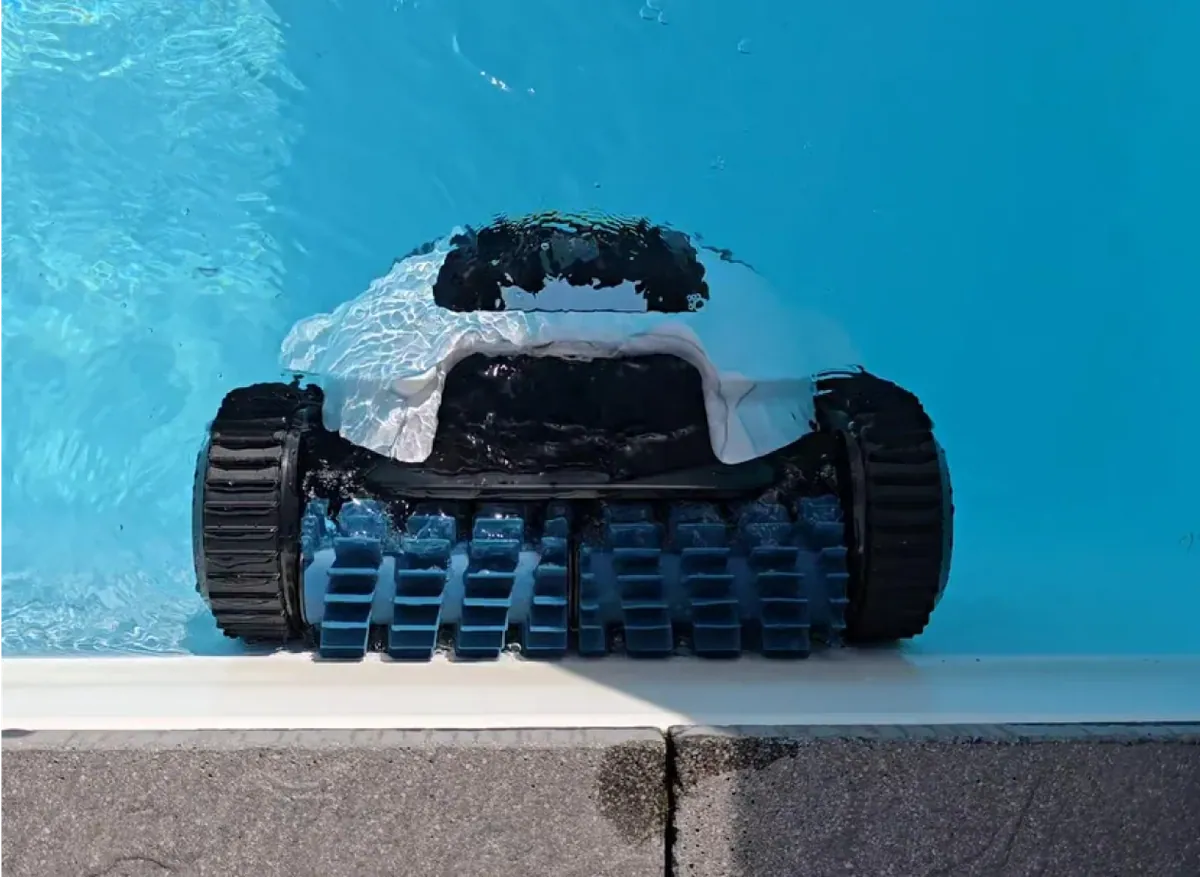 Image: Mammotion
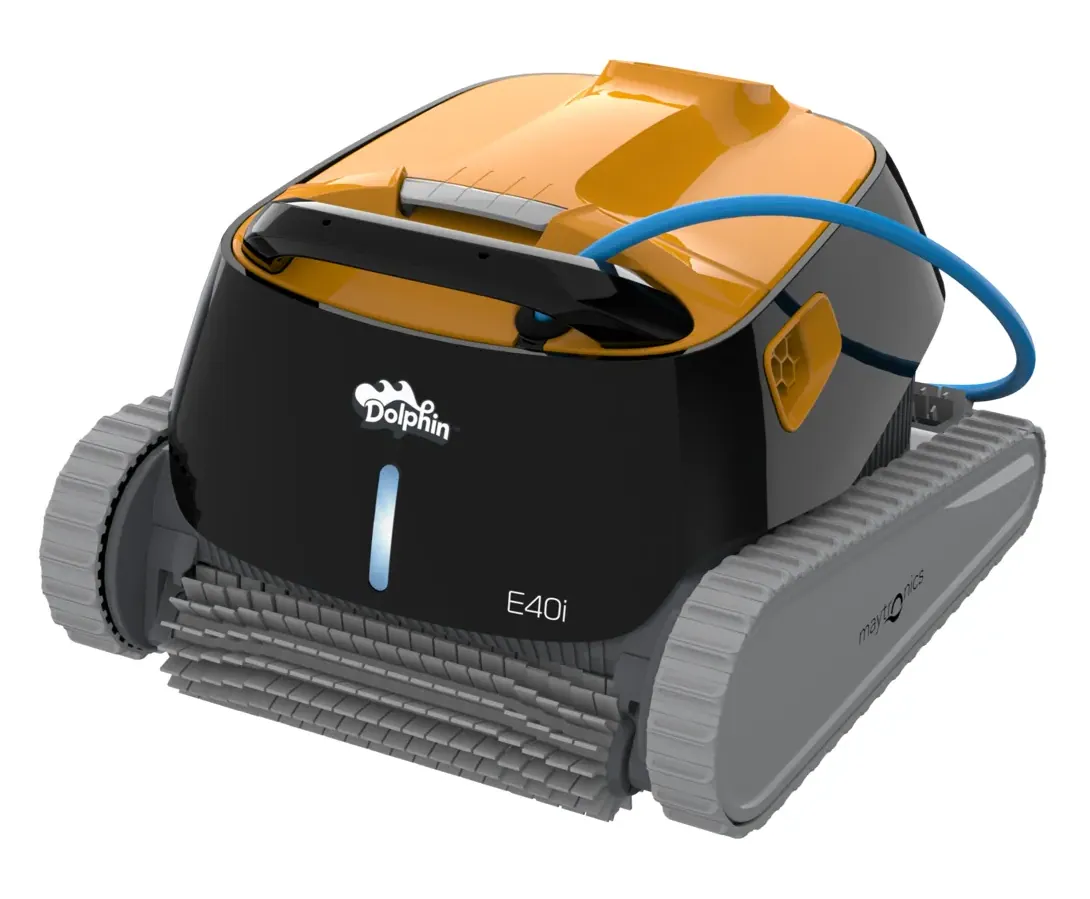 Image: Maytronics
Maytronics Dolphin E40i
Maytronics · Israel · Pool robots
- Height: 60.3 cm
- Weight: 8 kg
- Runtime per charge: 2 hrs
- Floor, walls, waterline
 Image: Intex
Beatbot Sora 70
Beatbot · China · 2026 · Pool robots
- Runtime per charge: 7 hrs
- Weight: 10.4 kg
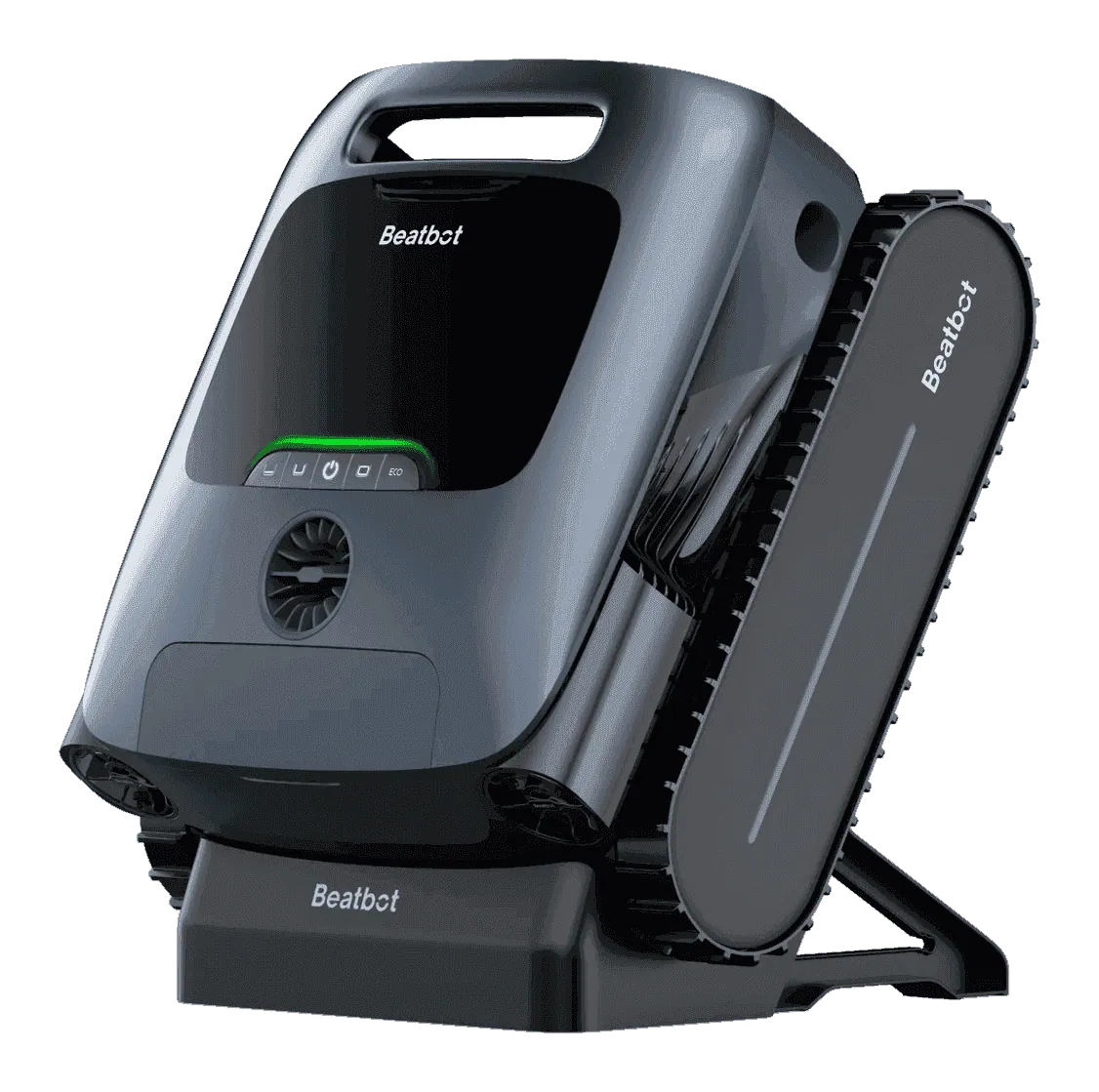 Image: Beatbot
Beatbot AquaSense Pro
Beatbot · Pool robots
- Runtime per charge: 9.5 hrs
- Pools up to 300 m²: floor, walls, waterline, surface, water clarification
Buying guide
A pool robot moves through the pool on its own, vacuums leaves, sand, insects and fine dust into its own filter basket and, depending on the model, also scrubs the walls and waterline. Above all, it saves time: instead of spending your weekend at the edge of the pool with a skimmer net and a manual vacuum, you put the device in the water and lift it out again once the cycle is done. The choice in 2026 is bigger than ever. Established pool brands such as Maytronics, Zodiac, Intex, Bestway and Steinbach compete with newcomers such as Aiper, Beatbot, WYBOT and Mammotion, and since 2026 Ecovacs, Mova and Dreame have been entering the pool market as well. At the same time, prices for good mid-range devices have dropped significantly.
To help you find the right pool robot, this buying guide explains what really matters: battery or corded, floor, walls and waterline, pool size and shape, filter fineness in microns (µm), navigation, suitability for above-ground pools, vinyl liners or tiles, cleaning time, charging and retrieval, as well as maintenance, winter storage and costs. One important note up front: we don't try out pool robots in a pool ourselves. All figures are based on manufacturer specifications, retailer data and specialist media, as of October 18, 2026.
Who is a pool robot worth it for?
A pool robot is worth it for almost anyone who uses their pool regularly and doesn't want to vacuum by hand several times a week. It makes particular sense in these cases:
- Pools under trees or hedges: Leaves, blossoms and pollen land in the water every day and sink to the bottom.
- Medium-sized and large in-ground pools: From around 30 to 40 square meters, manual vacuuming becomes tedious, and a ring of dirt made of sunscreen, pollen and limescale quickly forms at the waterline.
- Families with children: A pool that is used often gets a lot of sand and grass carried into the water.
- Vacation homes and second homes: When nobody is on site every day, a robot keeps the pool clean between visits.
A pool robot makes less sense for very small paddling pools that are emptied regularly anyway, or for above-ground pools that are only set up for a few weeks a year. In these cases, a simple manual vacuum is often enough. For small above-ground pools, however, there are now very affordable battery-powered floor cleaners from around €100, so the math can quickly work out there too.
What types of pool robots are there?
Before you compare spec sheets, it's worth looking at the design. Broadly speaking, there are five variants:
- Hydraulic cleaners without their own motor: They are powered by the water flow from the filter pump. The Intex ZX300, for example, is a pressure-side cleaner that, according to Intex, requires a pump output of 1,600 to 3,500 gallons per hour, which is about 6 to 13 cubic meters per hour. No battery, no power cable in the water, but also no programs or path planning.
- Corded pool robots: A power supply at the edge of the pool feeds the robot with low voltage via a floating cable. They run without charging breaks, but the cable length limits the pool size. Typical examples are the Dolphin models from Maytronics and the Ubbink Robotclean 2.
- Battery-powered floor cleaners: Small, lightweight devices that only clean the floor. Examples include the WYBOT WY1102 at 3.6 kilograms and the Bestway AquaTronix G100.
- Battery-powered all-rounders for floor, walls and waterline: Currently the largest group, such as the Mammotion SPINO E1, Aiper Scuba N1 Pro or Ecovacs Ultramarine P1.
- Premium models with surface cleaning: These devices also skim the water surface and catch leaves before they sink, some with a charging station or water clarification. They include the Beatbot Sora 70, Beatbot AquaSense Pro and Aiper Scuba V3.
Battery or corded pool robot: which is better?
The most important basic decision is between a cordless pool robot and a corded device. Both concepts have clear strengths.
Battery-powered pool robots (cordless) go into the water faster, don't get tangled and also work for pools without a power outlet at a safe distance. In return, they have to come out and be plugged in after every cycle. The runtime determines whether a pool can be finished in one cycle. The range is wide: according to a price comparison site, the Bestway AquaTronix G100 manages about 30 minutes, the WYBOT WY1102 about 50 minutes, the Mammotion SPINO E1 up to 210 minutes according to the manufacturer, and the Beatbot Sora 70 up to five hours on the floor according to the trade press. Charging time also counts: Mammotion states three hours for the SPINO E1, Zodiac around five hours for the Freerider RF 5600 iQ.
Corded pool robots run as long as they have power and maintain their performance throughout the entire cycle. For permanent in-ground pools where the device should run several times a week, they are often the more robust choice. A swivel in the cable, as Maytronics uses on the Dolphin E40i, is designed to prevent tangling. Drawbacks: the cable has to be laid out and stored, and the cable length limits the pool size.
As a rule of thumb: for above-ground pools and small to medium-sized pools, a battery-powered device is usually the more convenient solution today. If you have a large in-ground pool and want it cleaned daily, you should seriously consider corded devices.
The key buying criteria for pool robots
1. Cleaning zones: floor, walls, waterline, surface. First, clarify what the robot should handle. Floor-only cleaners such as the WYBOT WY1102, Ubbink Robotclean 2 or Dolphin E10 are inexpensive, but leave the ring of dirt at the waterline behind. A pool robot for floor and walls such as the Dolphin E20 climbs up the walls. According to the manufacturers, models that also clean the waterline include the Mammotion SPINO E1, Dolphin E30 and E40i, as well as the Aiper Scuba N1 Pro, which according to its spec sheet handles walls with an incline of up to 115 degrees. If you get a lot of leaves on the surface, you'll benefit from models with a surface mode.
2. Pool size and shape. Compare the manufacturer's stated maximum area or length with your pool. The figures range from around 18 square meters for simple floor cleaners to 50 square meters for the WY1102, 150 square meters for the SPINO E1 and 300 square meters for the AquaSense Pro. With corded devices, the cable length counts: according to a specialist retailer's table, the Dolphin E10 has 12 meters of cable for pools up to 8 meters, the E30 18 meters for pools up to 12 meters. Pay attention to the shape as well: according to the retailer, the Ubbink Robotclean 2 is only intended for rectangular, oval and round pools, not freeform ones. Many inexpensive floor cleaners can only cope with flat or slightly sloping floors.
3. Filter fineness in µm. The smaller the value, the finer the particles the filter retains. Coarse filters of around 150 to 180 µm catch leaves, sand and insects; pollen and fine dust require significantly finer stages. Examples: 180 µm on the WY1102 and the SPINO E1, two layers of 180 and 3 µm on the Ecovacs Ultramarine P1, 150 µm with an optional 3 µm fine filter on the Sora 70, 3 µm on the Scuba N1 Pro and 2 µm on the Robotclean 2. Ideally, look for a two-stage filter: coarse for leaves, fine for dust. However, the finer the filter, the faster it clogs.
4. Basket capacity and filter access. A large basket needs emptying less often. The Sora 70 offers six liters, the Scuba N1 Pro five liters. Top access, as on the Dolphin models, is cleaner in everyday use than a basket pulled out from underneath.
5. Navigation. Simple devices move randomly or in fixed patterns. Better models plan their paths: Mammotion calls this "SmartArc", Beatbot relies on ultrasonic mapping for the Sora 70, and Aiper uses a camera with on-device AI for the Scuba V3, which according to the manufacturer detects over 20 types of debris at up to two meters. Systematic paths shorten cleaning time and reduce missed spots. An app is handy for schedules and updates, but according to the trade press, the wireless connection usually drops out underwater.
6. Cleaning time and programs. A standard cycle usually takes one to three hours. According to Maytronics, the Dolphin E40i runs for two hours, or optionally 1.5 or 2.5 hours. Separate programs for floor only, waterline only or a quick cycle are useful when only one area is dirty.
7. Weight, charging and retrieval. A wet robot is heavy: all-rounders weigh from around 8 to over 10 kilograms, the SPINO E1 9.3 kilograms according to Mammotion. Helpful features include those that let the device drive to the waterline or the edge of the pool, as on the SPINO E1 or Scuba V3, Zodiac's remote-controlled lift system, or a transport cart, called a "Caddy" by Maytronics, which is included with the E40i. Charging stations such as the one on the Beatbot AquaSense X save you plugging it in altogether.
8. Warranty and spare parts. In our data, warranty periods range from one to three years. Check whether brushes, filters and batteries can be purchased separately.
Which pool robot is suitable for above-ground pools, vinyl liners or tiles?
The type of pool helps determine which model fits.
Pool robots for above-ground pools: With steel-wall, frame or quick-set pools, you lift the device over a high wall. A lightweight model such as the WY1102 at 3.6 kilograms is much more pleasant here than a ten-kilogram all-rounder. Manufacturers differ on whether a wall climber will grip a flexible wall. Mammotion explicitly mentions above-ground pools, but requires a water depth of at least 0.6 meters. Small quick-set pools are often too shallow for wall climbers. If you're planning a hydraulic cleaner, you need to check the pump output.
Vinyl-lined pools: Vinyl liners are more delicate than tiles and can wrinkle. Choose a model that the manufacturer explicitly approves for vinyl liners. Mammotion lists vinyl for the SPINO E1; for the Robotclean 2, the retailer lists liners and reinforced PVC. Also check the warranty terms of your liner manufacturer.
Tiled in-ground pools: Tiles are robust but slippery. What counts here are brushes with good grip and sufficient wall-climbing performance. Manufacturers such as Maytronics point out that climbing performance can decrease in cold water below 15 degrees.
How much does a pool robot cost?
Prices vary widely and often drop significantly a few months after launch. Broadly speaking, there are four price ranges:
- Up to €300: Hydraulic cleaners and simple floor cleaners. Examples from our database: Intex ZX300 for €160, WYBOT WY1102 for €289, Ubbink Robotclean 2 for €299. For small above-ground pools, there are battery-powered floor cleaners such as the Bestway AquaTronix G100 from around €104 according to a price comparison site.
- €300 to €1,000: Cordless all-rounders for floor, walls and waterline. The Mammotion SPINO E1 is listed in our data at €599 to €799 and was available from €429 according to a price comparison site on October 18, 2026. The Ecovacs Ultramarine P1 launched with a recommended retail price of €549. The Dolphin E series starts at around €908.
- €1,000 to €1,500: Proven corded devices and models with a camera. In our data, the Dolphin E series goes up to around €1,350, the Aiper Scuba V3 is at €1,299 and the Dolphin E40i at €1,489. The Beatbot Sora 70 is listed in our data at $1,499.
- Over €2,000: Premium models with surface cleaning, water clarification or a charging station, such as the Beatbot AquaSense Pro at €3,970.99 or the Mova Rover X10 at €2,499 at launch.
On top of the purchase price come running costs for replacement filters, brushes and possibly a new battery after a few years. Power consumption, on the other hand, is negligible. Compare the current price before you buy: manufacturer and retailer prices sometimes differ by several hundred euros.
Pool safety: what do you need to keep in mind?
Electricity and water call for care. The user manuals of established manufacturers are clear on this. For corded devices, Maytronics specifies:
- The power supply must be connected via a residual current device (GFCI/RCD) rated at no more than 30 mA.
- During operation, the power supply must be placed at least three meters from the edge of the pool.
- Nobody in the water: The robot is taken out of the pool before anyone goes swimming.
- During shock chlorination, the robot is taken out of the water.
Water values matter too: for one model, Maytronics specifies a water temperature of 6 to 35 degrees, a maximum of 4 ppm chlorine and a pH value of 7.0 to 7.8. Check the limits in your device's manual, especially for saltwater pools. Always charge battery-powered devices outside the water, in a dry place, and only with the supplied charger. For questions about electrical installations at the pool, consult a qualified electrician. Data privacy plays a minor role: models with an app and Wi-Fi transmit usage data; on the Aiper Scuba V3, the camera AI works locally according to the manufacturer. If in doubt, check the app's privacy policy.
Care, maintenance and running costs
A pool robot lasts longer if you follow a few routines:
- Rinse the filter after every use: Maytronics recommends rinsing the filter immediately after taking the robot out.
- Rinse with fresh water: This removes chlorine and salt residues, which is especially important for saltwater pools.
- Dry in the shade: According to Maytronics, strong sunlight damages plastics and seals. Don't leave the device permanently in the sun at the edge of the pool.
- Check the impeller: Maytronics advises clearing hair and fibers from the impeller about every two weeks, disconnecting the power first.
- Check brushes and tracks: Worn brushes reduce grip on the walls and waterline.
- Untwist the cable: On corded devices, regularly unroll the cable and straighten it out.
Running costs arise mainly from replacement filters, brushes and batteries. Before buying, ask whether these parts are available individually and will still be available in a few years.
Pool robots in winter: how do you store them properly?
At the end of the season, the robot doesn't belong in the garden shed if there's a risk of frost. Maytronics and Beatbot agree in their recommendations:
- Empty the robot completely and clean the filter and basket.
- Wipe the housing, brushes and wheels with fresh water and let everything dry completely in the shade.
- Coil the cable in loose loops without kinks.
- Store upright, ideally on a caddy, in a dry place protected from sun, rain and frost, at 5 to 45 degrees.
- According to Beatbot, store battery-powered devices with a charge level of about 50 to 80 percent, neither full nor empty, and don't leave them on the charger all winter.
Many battery-powered devices go into sleep mode after a longer break, at Maytronics after 21 days. Before the new season, connect the device to the charger, charge it fully and check the filter, brushes and moving parts.
Common mistakes when buying a pool robot
- Only looking at the price: An inexpensive floor cleaner skips the waterline. If you have the typical ring of dirt there, you need a device that cleans the waterline.
- Underestimating pool size: Runtime or cable length must match the pool, otherwise areas remain uncleaned.
- Ignoring pool shape and slope: Freeform pools, steps and steep slopes rule out some models.
- Not checking vinyl liner approval: Without explicit manufacturer approval, you risk damage and warranty trouble.
- Overlooking the minimum water depth: Many wall climbers need a minimum depth that shallow above-ground pools don't reach.
- Not checking the pump output for hydraulic cleaners: If the filter pump is too weak, the cleaner won't move properly.
- Forgetting the weight: Lifting a wet ten-kilogram robot over a high above-ground pool wall is hard work.
- Overlooking filter fineness: A coarse filter alone won't remove pollen and fine dust from the water.
- Not thinking about spare parts: Especially with new brands, filters, brushes and batteries should be available to buy.
Conclusion: how to find the right pool robot
There is no single best pool robot for everyone, but there is a clear order of questions. First: which zones should be cleaned – just the floor, or also the walls, waterline and surface? Second: does the manufacturer's specification match the size, shape, depth and material of your pool? Third: battery or corded, in other words convenience when putting it in versus unlimited runtime. Only then is it worth looking at filter fineness, navigation and convenience features such as waterline parking or a charging station.
For small above-ground pools, lightweight battery-powered floor cleaners are enough. For medium-sized to large pools, cordless all-rounders with wall and waterline cleaning are more affordable in 2026 than ever before. For large in-ground pools that need daily cleaning, corded devices remain a strong option. If you clarify these points, follow the safety rules and store the robot properly in winter, you'll enjoy a clean pool for many years.
Frequently asked questions
Battery or corded pool robot: which is better?
Battery-powered pool robots are ready to go quickly and free of cable clutter, but they have to come out and be charged after every cycle. Corded devices run without charging breaks and are particularly well suited to large in-ground pools that need frequent cleaning.
How long does a pool robot's battery last?
The range is wide: around 30 minutes for the Bestway AquaTronix G100, around 50 minutes for the WYBOT WY1102, up to 210 minutes for the Mammotion SPINO E1 and, according to the trade press, up to five hours on the floor for the Beatbot Sora 70. Charging usually takes three to five hours.
Which pool robot is suitable for an above-ground pool?
For small above-ground pools, lightweight battery-powered floor cleaners are practical because you have to lift the device over the wall. Wall climbers need manufacturer approval for above-ground pools and often a minimum water depth; for the Mammotion SPINO E1, it is 0.6 meters.
Does a pool robot clean the floor and walls?
Not every one does. Simple models such as the WYBOT WY1102 or Dolphin E10 only clean the floor, the Dolphin E20 cleans the floor and walls. According to the manufacturers, models such as the Mammotion SPINO E1, Dolphin E30 or Aiper Scuba N1 Pro also clean the waterline.
What filter fineness should a pool robot have?
For leaves, sand and insects, 150 to 180 µm is enough. For pollen and fine dust, a fine filter of 2 to 3 µm makes sense; a two-stage filter is ideal.
How much does a good pool robot cost?
Hydraulic cleaners and simple floor cleaners are available from around €100 to €300, cordless all-rounders for floor, walls and waterline usually cost €400 to €1,000. Proven corded devices and camera models cost €1,000 to €1,500, and premium models with surface cleaning more than €2,000.
Can the pool robot stay in the pool while people are swimming?
No. Manufacturers such as Maytronics require the robot to be taken out of the water before swimming, and also during shock chlorination. After use, it should be rinsed with fresh water and dried in the shade.
Is there a pool robot test by Stiftung Warentest?
According to our research, Stiftung Warentest had not published an evaluation of pool robots as of October 18, 2026. Be critical of advertising that uses a corresponding seal.
Buying guide sources
- Maytronics: Bedienungsanleitung Basic 19 (Sicherheit, Wasserwerte, Lagerung) (brand.maytronics.com)
- Maytronics: Robotic Pool Cleaner Storage During Winter (maytronics.com)
- Maytronics: How to Maintain Your Robotic Pool Cleaner (maytronics.com)
- Beatbot: How to Store a Robotic Pool Cleaner for the Off-Season (beatbot.com)
- Mammotion: SPINO E1 Produktseite (uk.mammotion.com)
- Intex: ZX300 Deluxe Automatic Pool Cleaner (intexcorp.com)
- Zodiac: Freerider RF 5600 iQ (zodiac-poolcare.com)
- Notebookcheck: Ecovacs Ultramarine P1 (notebookcheck.com)
- Esta: Vergleichstabelle Maytronics Dolphin (esta-poolshop.de)
- Leobotics: WYBOT WY1102 (de.leobotics.com)
- netzwelt: Beatbot Sora 70 (netzwelt.de)
- Notebookcheck: Aiper Scuba V3 (notebookcheck.com)
- Geizhals: Mammotion SPINO E1 (Preis) (geizhals.at)
- Bricomarché: Ubbink Robotclean 2 (bricomarche.com)
- Preisvergleich: Bestway AquaTronix G100 (preissuchmaschine.de)